You’ve crossed into six figures. That’s a real milestone, and buying a home feels like the obvious next move.
But here’s the thing nobody tells you upfront: your $100,000 salary and your actual buying power are two very different numbers. At today’s mortgage rates — hovering around 6.6% for a 30-year fixed — a $100K income gets you further in Kansas City than it does in Seattle, and the real monthly cost of homeownership goes well beyond whatever your lender quotes you.
This guide breaks everything down honestly, with real numbers for 2026.
Quick Answer: How Much House Can You Afford on $100K?
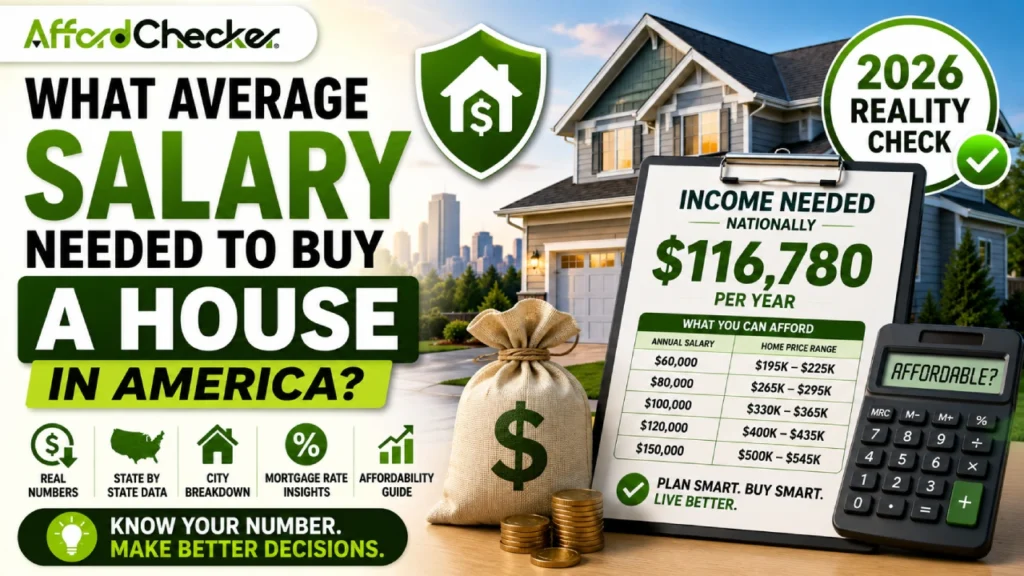
As a general guideline, a $100,000 salary supports a home purchase in the $300,000 to $450,000 range in 2026 — depending heavily on your down payment, debt load, credit score, and where you’re buying.
Here’s the fast breakdown:
| Situation | Affordable Home Price |
|---|---|
| High debt, small down payment | $250,000 – $310,000 |
| Average debt, 10% down | $320,000 – $380,000 |
| Low/no debt, 20% down | $380,000 – $450,000 |
The national median home price hit approximately $403,200 in Q1 2026, according to the U.S. Census Bureau. That puts the median home technically within reach on a $100K salary — but only with the right financial setup.
Let’s look at what that actually means in practice.
First, What Does $100K Actually Take Home?
This is the single most important thing none of the other guides tell you, and it changes everything.
Your gross salary is $100,000. Your take-home pay — the money that actually hits your bank account — is significantly less. Here’s what that looks like:
Federal taxes and FICA (2026 estimates, single filer):
- Federal income tax: ~$17,000
- Social Security (6.2%): $6,200
- Medicare (1.45%): $1,450
- Total federal deductions: ~$24,650
Take-home by state:
| State | Monthly Take-Home |
|---|---|
| Texas / Florida (no income tax) | ~$6,280 |
| Illinois (4.95% flat tax) | ~$5,865 |
| New York (~5.9% effective) | ~$5,870 |
| California (~6.8% effective) | ~$5,800 |
That’s a difference of nearly $500/month depending on where you live — before you even consider housing costs.
The reason this matters: mortgage lenders qualify you on gross income. But you’re making your actual monthly payment from your take-home pay. Those aren’t the same number, and conflating them is how people end up house-poor.
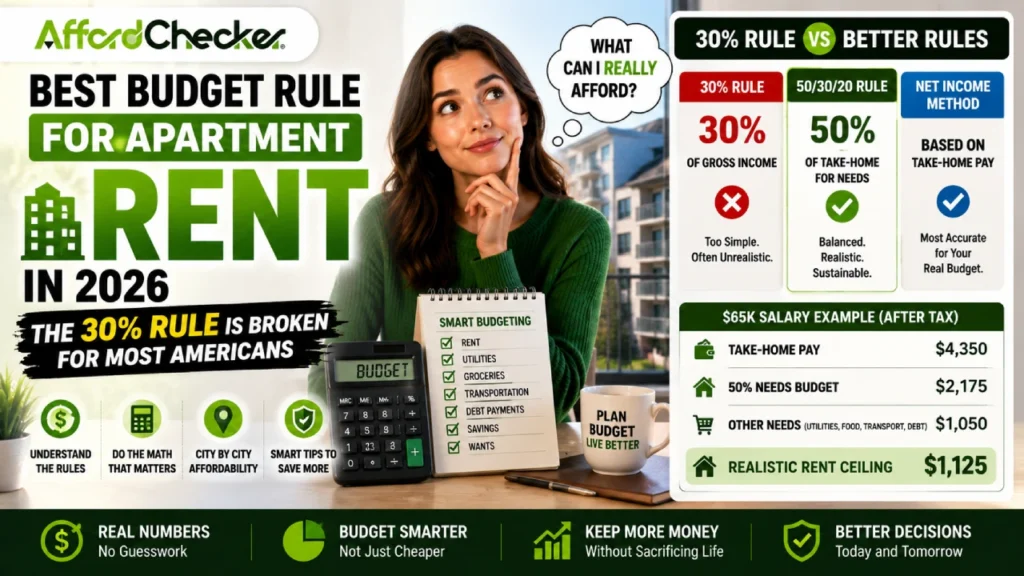
The 28% Rule: What It Means on $100K
Most lenders use the 28/36 rule as their baseline. It says:
- No more than 28% of your gross monthly income should go toward housing costs (mortgage, taxes, insurance)
- No more than 36% should go toward all debt (housing + car payments + student loans + credit cards)
On $100,000, your gross monthly income is $8,333.
That gives you:
- Max housing payment: $2,333/month
- Max total debt payments: $3,000/month
At today’s rate of 6.6% for a 30-year fixed, a $2,333 monthly payment (principal + interest only) supports a loan of roughly $365,000. Add a 10% down payment and you’re looking at a $405,000 home.
But that’s principal and interest only. Real homeownership costs more. We’ll cover that in a moment.
3 Real Budget Scenarios for $100K Earners
These examples use current 2026 conditions: 6.6% interest rate, average property taxes of 1.1%, and homeowners insurance of approximately $1,400/year.
High Debt, Low Down Payment – Scenario 1
Profile: $800/month in existing debt (car + student loans), 5% down
- Home price: $320,000
- Down payment: $16,000
- Loan amount: $304,000
- Monthly principal + interest: $1,942
- Property taxes: $293
- Homeowners insurance: $117
- PMI (0.8%): $203
- Total monthly housing cost: $2,555
Housing + existing debt = $3,355/month = 40.3% of gross — this exceeds the 36% guideline and may face lender pushback. Many lenders will still approve up to 43-45% DTI, but your financial cushion gets thin.
Moderate Debt, 10% Down – Scenario 2
Profile: $400/month in existing debt, 10% down, 720 credit score
- Home price: $360,000
- Down payment: $36,000
- Loan amount: $324,000
- Monthly principal + interest: $2,069
- Property taxes: $330
- Homeowners insurance: $121
- PMI (0.8%): $216
- Total monthly housing cost: $2,736
Housing + existing debt = $3,136/month = 37.6% of gross — slightly over the classic 36% guideline but within reach of many lenders’ 43% DTI ceiling. This is the reality for most $100K earners today.
No Debt, 20% Down (Ideal Scenario) – Scenario 3
Profile: Zero monthly debt payments, 20% down, 760+ credit score
- Home price: $420,000
- Down payment: $84,000
- Loan amount: $336,000
- Monthly principal + interest: $2,147
- Property taxes: $385
- Homeowners insurance: $131
- No PMI
- Total monthly housing cost: $2,663
Total debt + housing = $2,663/month = 31.9% of gross — comfortably within the 28% guideline. This is the best-case version of a $100K buyer in today’s market.
How Your Credit Score Costs (or Saves) You Thousands
Nobody in the top search results really quantifies this, so let’s be direct.
Your credit score directly determines your interest rate. At the same $320,000 loan amount, here’s what different scores actually cost you per month — and over 30 years:
| Credit Score | Approximate Rate | Monthly P&I | Extra Cost vs 760+ |
|---|---|---|---|
| 760+ (Excellent) | 6.3% | $1,983 | — |
| 720–759 (Good) | 6.6% | $2,045 | +$62/month |
| 680–719 (Fair) | 6.9% | $2,109 | +$126/month |
| 640–679 (Poor) | 7.4% | $2,213 | +$230/month |
| 620–639 (Minimum conv.) | 7.8% | $2,296 | +$313/month |
A buyer with a 640 credit score pays $313 more per month than a buyer with 760+. That’s $3,756/year — and $112,680 over the life of the loan. Spending 6-12 months improving your credit before you buy is one of the highest-return financial moves you can make.
City-by-City: Where $100K Goes Far vs. Where It Falls Short
This is the reality check most guides skip. Same salary, very different outcomes based on location.
| City | Median Home Price* | Verdict for $100K Earner |
|---|---|---|
| Pittsburgh, PA | ~$208,000 | Very comfortable — strong buying power |
| Kansas City, MO | ~$265,000 | Comfortable — many options in budget |
| Indianapolis, IN | ~$276,000 | Comfortable — Midwest affordability |
| Chicago, IL | ~$315,000 | Manageable with 10-15% down |
| Dallas, TX | ~$380,000 | Doable with minimal debt, 10%+ down |
| Austin, TX | ~$440,000 | Tight — requires strong finances |
| Denver, CO | ~$570,000 | Very challenging — likely needs dual income |
| Seattle, WA | ~$680,000 | Out of reach solo |
| Los Angeles, CA | ~$800,000 | Out of reach on $100K alone |
| San Francisco, CA | ~$1.1M+ | Not viable without significant assets |
*Approximate Zillow Home Value Index figures, 2026
If you have the flexibility to work remotely, moving from a high-cost market to one where $100K puts you at a comfortable income level can literally be worth hundreds of thousands of dollars in buying power.
The True Monthly Cost of Owning a Home
Here’s what a lot of calculators leave out. Your mortgage payment is just one piece. The real number includes:
For a $370,000 home with 10% down ($333,000 loan at 6.6%):
| Cost Component | Monthly Estimate |
|---|---|
| Principal + Interest | $2,128 |
| Property Taxes (1.1%) | $339 |
| Homeowners Insurance | $125 |
| PMI (if <20% down) | ~$222 |
| Basic PITI subtotal | $2,814 |
| HOA Fees (if applicable) | $0 – $500 |
| Home Maintenance (1% annually) | +$308 |
| Utility increase vs. renting | +$200 – $400 |
| Realistic true monthly cost | $3,100 – $3,600 |
That maintenance number deserves attention. The 1% rule of thumb — budgeting 1% of your home’s value per year for maintenance — puts you at $3,700/year on a $370,000 home. Older homes often run 2-3%. New construction is usually less. Either way, this money doesn’t show up in mortgage calculators and it’s real money that goes out the door every year.
How Much Cash Do You Actually Need to Close?
Down payment is what most people think about. But there are several more line items you need to have ready before you can hand over the keys.
Example: $350,000 home, 10% down
| Cash Needed | Amount |
|---|---|
| Down payment (10%) | $35,000 |
| Closing costs (3–4% of loan) | $9,450 – $12,600 |
| Moving costs | $1,500 – $4,000 |
| Immediate repairs / appliances | $2,000 – $8,000 |
| 3-month emergency reserve | $8,400 |
| Total cash to have ready | $56,350 – $68,000 |
That’s a wide swing but it’s honest. Many buyers show up with exactly their down payment and get blindsided by closing costs alone. Having closer to $65,000 ready for a $350,000 purchase keeps you from starting homeownership in a cash crunch.
If you’re looking at a 20% down payment on a $400,000 home, plan on having $90,000+ liquid before you even start seriously shopping.
Loan Types Available on a $100K Salary
Conventional Loans Most common, requires credit score of 620+. You can put as little as 3% down (5% for non-first-time buyers). If you put less than 20% down, expect PMI until you hit 80% loan-to-value. These loans work well for buyers with stable income and decent credit.
FHA Loans Backed by the Federal Housing Administration. Credit scores as low as 580 qualify with 3.5% down. Scores between 500–579 require 10% down. The trade-off: FHA loans carry both an upfront mortgage insurance premium (1.75% of loan amount) and an annual premium for the life of the loan in most cases — which adds up.
VA Loans If you’re a veteran, active-duty service member, or qualifying surviving spouse, VA loans offer zero down payment and no PMI. One of the best financial products in existence if you qualify. The VA doesn’t set a minimum credit score, though most lenders want 620+.
USDA Loans Zero down payment for low-to-moderate income borrowers purchasing in eligible rural areas. Income limits apply — for a $100K salary, you may be at or above the limit depending on household size and location. Worth checking if you’re open to rural or suburban areas.
How to Stretch Your Buying Power
Pay off debt before you buy. If you can eliminate $400/month in car or student loan payments before applying for a mortgage, that’s an extra $30,000-$50,000 in home you can qualify for — without changing your salary at all.
Improve your credit score first. Getting from 680 to 760 before closing saves you thousands annually. Give yourself 6-12 months if needed.
Look into down payment assistance (DPA). Many states and municipalities offer grants, forgivable loans, or favorable second mortgages for first-time buyers. Programs vary widely — HUD’s website lists options by state at hud.gov.
Consider a 15-year mortgage if you can swing it. At today’s rates, 15-year fixed mortgages average around 5.87%. A higher monthly payment, but you build equity much faster and save enormously in total interest.
Buy below your maximum. Lenders will often approve you for more than you’re comfortable paying. A $450,000 approval doesn’t mean you should spend $450,000. Aim for a home that costs 2.5-3x your annual income — roughly $250,000-$300,000 — and give yourself financial breathing room.
Pros and Cons of Buying a Home on a $100K Salary
Pros
- Build equity over time instead of paying a landlord
- In many cities, your mortgage payment will be less than rent
- Tax advantages: mortgage interest deduction, property tax deduction
- Fixed-rate mortgage = protection against rent hikes
- Long-term wealth building through appreciation
- Freedom to customize your own space
Cons
- Current rates (~6.6%) significantly reduce buying power vs. 3 years ago
- High-cost cities make homeownership nearly impossible on $100K alone
- Requires substantial cash to close — often $50,000–$80,000+
- Maintenance and unexpected repairs can strain budgets
- Less financial flexibility if income changes
- Inflation (now 3.8% annually) further squeezes budgets
Smart Recommendation for $100K Earners in 2026
The honest answer: your $100K income can support homeownership, but market conditions in 2026 require more discipline than in previous years.
With rates near 6.6% and median home prices sitting at $403,000, the math is tighter than it was even three years ago. Here’s the practical playbook:
1: Calculate your real take-home pay. Your budget is built on that number, not your gross salary.
2: Add up every dollar of monthly debt. If it’s above $400-500/month, seriously consider aggressively paying it off before applying for a mortgage.
3: Build your credit to 720+ before shopping. Even 760+ if possible.
4: Set a target home price of 2.5–3x your salary — roughly $250,000–$300,000 — and treat the upper range of $400,000–$450,000 as your ceiling, not your target.
5: Have at least 10-20% for down payment plus another 3-4% for closing costs sitting in savings before you make an offer.
6: Shop multiple lenders. Rate differences of even 0.25% can save you $15,000+ over the loan term.
Alternatives Worth Considering
Buy a condo or townhome. A lower purchase price gets you into ownership and starts building equity. HOA fees apply, but purchase prices are often $50,000–$100,000 less than comparable single-family homes.
House hacking. Buying a small multi-unit property (duplex, triplex) and renting out other units is one of the smartest moves for $100K earners in expensive markets. Rental income offsets your mortgage — sometimes significantly.
Target a more affordable city. If remote work is on the table, the difference between buying in Pittsburgh and buying in Denver on the same salary is essentially the difference between comfortable and barely qualifying. That’s worth thinking about seriously.
Wait and save more. If you’re currently sitting at 5% for a down payment, 18 more months of aggressive saving to reach 20% means no PMI, lower monthly payments, and more competitive offers. In a market that’s softened slightly, that trade-off often makes sense.
FAQs
Yes, $100K puts you above the national median income (~$83,730 per the Census Bureau) and is enough to buy a home in most U.S. markets — provided you have manageable debt, a solid down payment, and aren’t buying in a coastal high-cost city like Los Angeles or New York.
Using the 28% rule, your maximum housing payment (principal, interest, taxes, and insurance) should stay around $2,333/month on $100K gross income. With debt obligations, your total debt payments should ideally stay under $3,000/month.
Yes, but it requires favorable conditions: a 20% down payment, minimal debt, and a credit score of 720+. With high debt or a small down payment, $400,000 pushes well above the 36% DTI guideline that most lenders prefer.
Mortgage rates are around 6.6% — elevated compared to the pandemic lows but historically close to the long-term average. Home prices have softened slightly from their 2024 peak. If you’re financially ready, waiting for rates to drop is a gamble; you can always refinance later if rates improve significantly.