Buying a home on a $50,000 salary in 2026 feels like trying to fit a king-sized bed into a studio apartment. Prices are high. Mortgage rates are still elevated. And everyone keeps telling you homeownership is the path to wealth — but nobody’s showing you exactly how to walk it on your income.
Here’s the honest answer: yes, you can buy a house on $50K a year. But the devil is in the details. Your location, debts, credit score, and down payment will decide whether that home is a solid starter or a financial stretch you’ll regret.
This guide breaks it all down — including what competitors won’t tell you: what $50K actually looks like after taxes, which cities are still realistic, and whether renting might actually be smarter right now.
Quick Answer: Can You Buy a House on $50K?
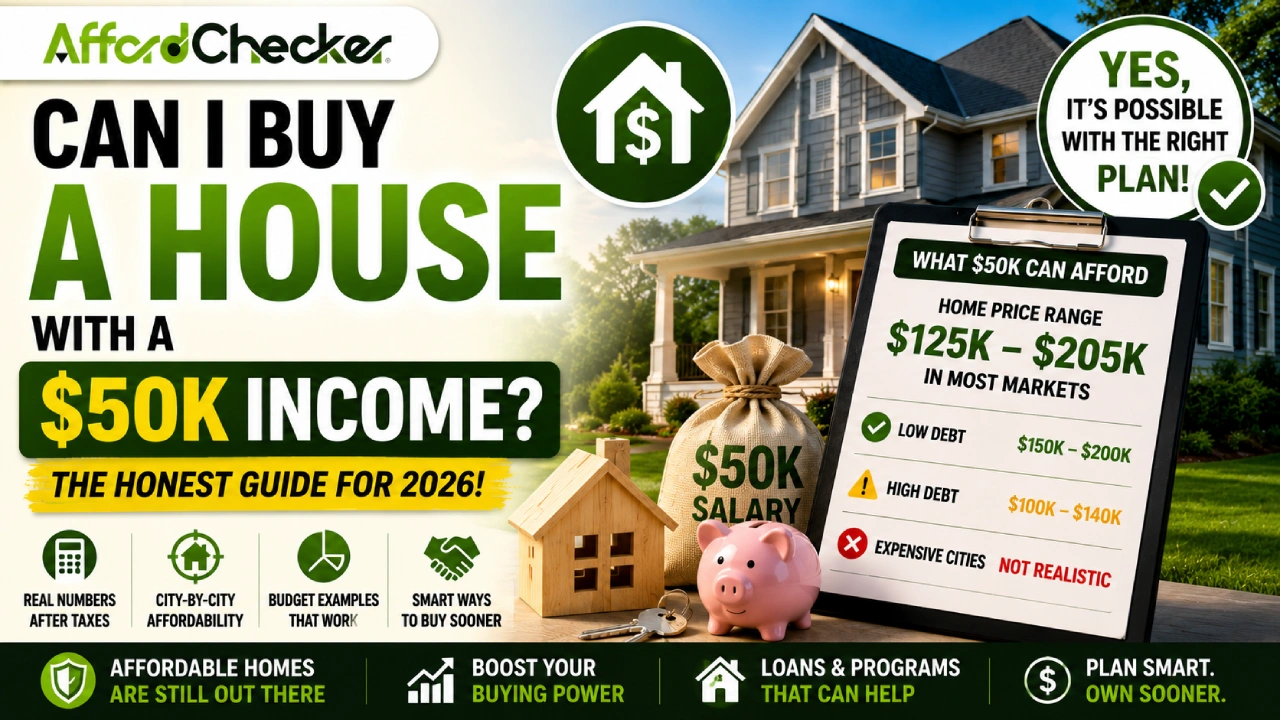
Yes — but your price range is $125,000 to $205,000 in most markets.
- With little debt and a 10–20% down payment, you can comfortably afford a home between $150,000 and $200,000.
- With high existing debt, that range drops to $100,000–$140,000.
- In expensive cities like Los Angeles, Seattle, or Miami, $50K won’t realistically get you into homeownership without significant help.
- In affordable metros like Cleveland, Memphis, Pittsburgh, or St. Louis, $50K can absolutely make you a homeowner.
The national median home price is around $405,000 as of early 2026. At $50K, you’re shopping well below the median — which means your city choice matters more than almost anything else.
What $50K Actually Looks Like After Taxes
This is what most housing articles skip — and it’s the most important number you need to know.
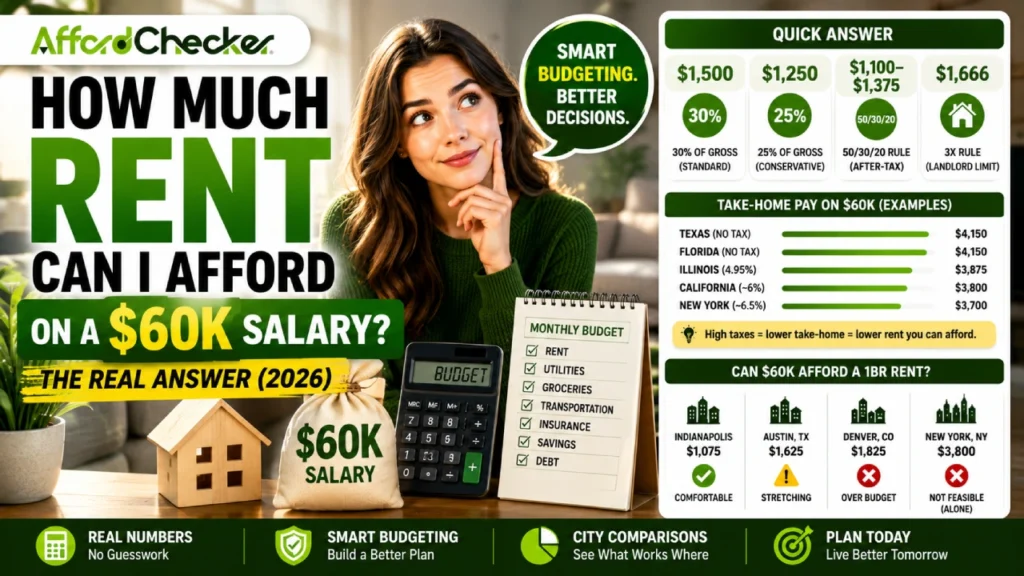
Your gross income is $50,000 a year. But your take-home pay — what actually lands in your bank account — is a different story.
Estimated monthly take-home by state (single filer, 2026):
| State | Monthly Gross | Est. Federal Tax + FICA | State Tax | Monthly Take-Home |
|---|---|---|---|---|
| Texas (no state tax) | $4,167 | ~$648 | $0 | ~$3,519 |
| Florida (no state tax) | $4,167 | ~$648 | $0 | ~$3,519 |
| Ohio | $4,167 | ~$648 | ~$130 | ~$3,389 |
| Pennsylvania | $4,167 | ~$648 | ~$130 | ~$3,389 |
| California | $4,167 | ~$648 | ~$180 | ~$3,339 |
| New York | $4,167 | ~$648 | ~$180 | ~$3,339 |
Estimates based on standard deduction, no dependents. Actual amounts vary.
So in most states, your real monthly budget starts at roughly $3,339 to $3,519 — not $4,167.
Lenders calculate mortgage eligibility based on your gross income. But you pay your bills with your net income. That gap matters a lot when you’re planning a budget.
Main Analysis: How Much House Can You Afford?
The 28/36 Rule — What Lenders Actually Use
Mortgage lenders use the 28/36 rule as the standard guideline:
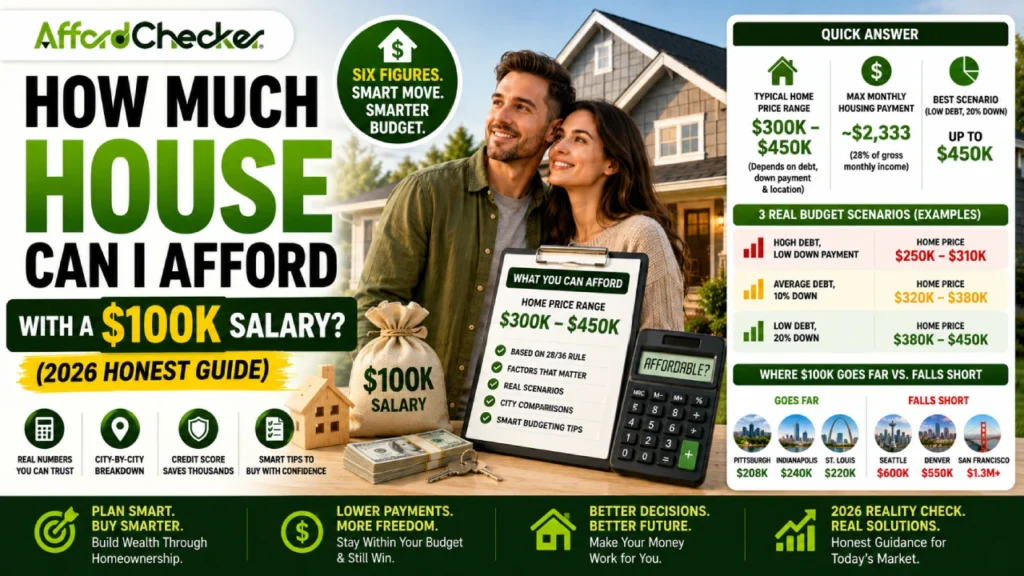
- 28% front-end ratio: Your monthly housing cost (mortgage + taxes + insurance) should not exceed 28% of your gross monthly income.
- 36% back-end ratio: All monthly debt payments combined (housing + car + student loans + credit cards) should not exceed 36% of gross monthly income.
For a $50K salary, that math looks like this:
- Gross monthly income: $4,167
- Max housing payment (28%): $1,167/month
- Max total debt (36%): $1,500/month
So if you have a $400/month car payment and $200 in student loans, your remaining room for a mortgage payment is only $900/month — which limits you to homes around $100,000–$120,000 depending on rates and taxes.
That’s why debt is your biggest obstacle at $50K — even more than your income itself.
Affordability Breakdown: What Can $50K Buy in 2026?
By Interest Rate (3% down, no other debts, 30-year fixed)
| Interest Rate | Max Monthly Payment | Estimated Home Price |
|---|---|---|
| 6.0% | $1,167 | ~$173,000 |
| 6.5% | $1,167 | ~$165,000 |
| 7.0% | $1,167 | ~$157,000 |
| 7.5% | $1,167 | ~$150,000 |
With rates in the 6.5–7% range in 2026, a clean-debt borrower can realistically afford a home priced around $155,000–$175,000.
By Debt Level (6.5% rate, 3% down, 30-year fixed)
| Monthly Existing Debt | Max Mortgage Payment | Estimated Home Price |
|---|---|---|
| $0 | $1,167 | ~$165,000 |
| $200 | $967 | ~$130,000 |
| $400 | $767 | ~$97,000 |
| $600 | $567 | ~$63,000 |
The message is clear: every $200 in monthly debt shaves roughly $35,000 off your home buying budget.
City-by-City Reality Check
This is what your $50K salary actually gets you across America in 2026:
| City | Median Home Price | Affordable on $50K? | Notes |
|---|---|---|---|
| Cleveland, OH | ~$140,000 | ✅ Yes | Strong buyer’s market |
| Memphis, TN | ~$170,000 | ✅ Yes | Lots of FHA-eligible homes |
| Pittsburgh, PA | ~$200,000 | ✅ With planning | Strong neighborhoods, low taxes |
| St. Louis, MO | ~$185,000 | ✅ Yes | Low cost of living |
| Indianapolis, IN | ~$240,000 | ⚠️ Tight | Need low debt + assistance |
| Columbus, OH | ~$270,000 | ⚠️ Challenging | Need DPA program |
| Dallas, TX | ~$380,000 | ❌ Very difficult | Need significant down payment |
| Denver, CO | ~$510,000 | ❌ Unlikely | Far above $50K reach |
| Los Angeles, CA | ~$800,000 | ❌ Not realistic | Income gap is too large |
If you live in a high-cost city, the most practical path to homeownership at $50K is either to look in the suburbs/exurbs, explore rural loan programs, or plan to increase income before buying.
Salary & Expense Examples: The Full Monthly Budget
Here’s what real life looks like as a $50K homeowner in an affordable market (Cleveland, OH):
Scenario: Single buyer, $50K salary, $155,000 home, 5% down, 6.5% rate
| Expense | Monthly Cost |
|---|---|
| Mortgage (P&I) | $940 |
| Property taxes (est.) | $150 |
| Homeowners insurance | $80 |
| Total housing cost | $1,170 |
| Utilities (electric, gas, water) | $175 |
| Groceries | $350 |
| Transportation (car payment + gas + insurance) | $500 |
| Health insurance (employer plan) | $200 |
| Phone + internet | $120 |
| Subscriptions / misc | $60 |
| Emergency savings (recommended 10%) | $352 |
| Total Monthly Spending | $2,927 |
| Take-home remaining | ~$592 |
This budget is workable — but tight. There’s not much cushion. This is why financial advisors consistently recommend having 3–6 months of expenses saved before buying, plus 1% of your home’s value set aside annually for repairs and maintenance (about $1,550/year on a $155K home).
🏦 Mortgage Options for $50K Buyers
Conventional Loans
Require a minimum 3% down payment, a credit score of at least 620, and a DTI under 45%. If you put down less than 20%, you’ll pay Private Mortgage Insurance (PMI) — typically 0.3%–1.5% annually — which adds $40–$200/month on a $150K loan. PMI drops off once you hit 20% equity.
Best for: Buyers with good credit (680+) and manageable debt.
FHA Loans
Backed by the Federal Housing Administration, these loans accept credit scores as low as 580 (with 3.5% down) or even 500 (with 10% down). DTI limits can go as high as 50% with compensating factors. The tradeoff: you pay mortgage insurance for the life of the loan if you put down less than 10%.
Best for: First-time buyers with lower credit or limited savings.
VA Loans
For active-duty military, veterans, and eligible surviving spouses. Zero down payment required, no PMI, and competitive interest rates. This is widely considered the best mortgage deal available in America.
Best for: Anyone who has served in the military — always explore this first.
USDA Loans
The most underused program for $50K buyers. If you’re open to living in a rural or suburban area designated by the U.S. Department of Agriculture, you could qualify for a zero-down-payment loan with below-market interest rates. Income limits apply — around $110,650 for a 1–4 person household in most areas — and $50K falls comfortably within range.
Check the USDA’s eligibility map at usda.gov. More areas qualify than most people realize, including towns on the edges of mid-size cities.
Best for: Buyers willing to live outside major metros. Potentially the single best program for $50K income buyers.
One Important Note on PMI
At $50K, putting 20% down on a $150K home ($30,000) is a significant hurdle. Most buyers at this income level use a 3%–5% down payment and pay PMI. That’s fine — just factor it into your monthly budget. Once your equity reaches 20%, you can request PMI cancellation.
Pros & Cons of Buying a Home at $50K
Pros
- Building equity instead of paying rent — every mortgage payment builds ownership
- Fixed housing cost — unlike rent, a fixed-rate mortgage payment doesn’t increase
- Tax advantages — mortgage interest may be deductible in some situations
- Affordable programs exist — FHA, USDA, VA, and state-level DPA programs are designed for buyers at this income level
- Strong markets available — many Midwest and Southern cities offer great homes under $200K
Cons
- Tight monthly budget — little room for financial surprises
- Most major cities are out of reach — the gap between $50K and median home prices in expensive metros is too wide
- High debt kills your options fast — even moderate existing debt severely limits affordability
- Maintenance costs — owning a home comes with surprise expenses that renters don’t face
- Slower savings rate — buying early may leave you with no emergency buffer
Smart Recommendation: Should You Buy Now or Wait?
Buy now if:
- You have less than $300 in monthly debt payments
- You have a credit score of 660 or higher
- You have 3%–5% saved for a down payment plus 2–3 months of expenses in savings
- You’re buying in an affordable market (Midwest, Southeast, rural areas)
- You plan to stay for at least 5 years
Wait and plan if:
- You’re carrying over $400/month in debt — focus on eliminating it first
- Your credit score is below 620 — 6–12 months of credit repair can save you thousands
- You don’t yet have a down payment — use the time to save aggressively
- You’re living in a high-cost metro — consider a different city or suburb
The smartest move for most $50K buyers isn’t buying immediately — it’s getting mortgage-ready in 12–18 months. Improve your credit by 30–50 points, eliminate a car payment or credit card, save $8,000–$12,000 for a down payment and closing costs, and you’ll qualify for a much better loan with a lower rate.
That extra planning can drop your rate by 0.5%–1.0%, saving you $15,000–$25,000 over the life of a loan.
Rent vs. Buy at $50K: The Honest Comparison
This section is missing from every major competitor — but it’s the question most $50K earners really need answered.
When renting beats buying:
- You’re in a high-cost city where rent is still cheaper than owning
- You may move within 3–4 years (transaction costs eat your equity)
- Your debt or credit score would force you into a high-interest loan
- You don’t yet have an emergency fund
When buying beats renting:
- Your mortgage payment is equal to or less than local rent
- You plan to stay put for 5+ years
- You’re in an affordable market where home values appreciate steadily
- Your debt is low and credit is solid
In most affordable Midwest and Southern markets, a $150K mortgage payment is often lower than a 2-bedroom apartment rent — making buying a genuinely smart financial move at $50K.
In coastal cities, buying rarely makes sense at this income level.
Alternative Options: How to Afford More
1. Apply for Down Payment Assistance (DPA)
Every state offers DPA programs — grants or forgivable loans that help cover your down payment and closing costs. Many have income limits that specifically target $50K earners. Start at your state housing finance agency’s website or HUD.gov.
2. Buy With a Co-Borrower
Combining incomes with a spouse, partner, or family member can double your purchasing power. Two $50K earners buying together qualify for an $800 mortgage payment each — combined, that’s a $1,600 budget that opens up significantly more options.
3. Consider a Multi-Family Property
Purchase a duplex, triplex, or small fourplex using an FHA loan (3.5% down) and live in one unit while renting out the others. The rental income counts toward your qualification, and you could offset $500–$1,000 of your monthly mortgage. This is one of the most overlooked wealth-building strategies for lower-income buyers.
4. Target USDA-Eligible Areas
Moving 20–30 minutes outside a major city can unlock USDA eligibility — zero down payment, below-market rates, and home prices often $50,000–$100,000 lower than the metro median. It’s a legitimate path thousands of $50K buyers use every year.
5. Buy a Fixer-Upper
Cosmetic fixer-uppers in good neighborhoods routinely sell for 10%–20% below market. If you’re handy, this can get you into a home priced $20,000–$30,000 less than a move-in-ready comparable. Always get a full inspection — you want cosmetic issues, not structural ones.
6. Save Strategically — Set a 12-Month Goal
Open a dedicated HYSA (High-Yield Savings Account), set an automatic transfer of $500–$700/month, and in 12–18 months you’ll have your down payment and closing costs covered. Treat it like a bill, not a choice.
FAQs
Yes — through VA loans (if you’re a veteran) or USDA loans (for eligible rural areas). Both offer zero-down-payment options. FHA loans require at least 3.5% down, which is about $5,250 on a $150K home.
Most conventional loans require a 620+ credit score. FHA accepts scores as low as 580. The better your score, the lower your interest rate — which directly increases how much house you can afford. A 720+ score is ideal.
In affordable markets — yes, absolutely. In high-cost cities — no, not realistically. Your city matters more than almost any other factor at this income level.
If you live in or are open to a rural/suburban area, USDA is almost always the better deal — zero down, lower mortgage insurance than FHA, and competitive rates. If you need to stay in a city, FHA is your most flexible fallback.
Final Verdict
Buying a house on a $50,000 income in 2026 is possible — but only if you’re strategic.
The biggest mistakes $50K buyers make: ignoring how much their debts limit their mortgage, buying in markets that are simply too expensive for their income, and skipping the preparation that would’ve gotten them a much better rate.
The winning formula is straightforward: low debt + decent credit + right market + the right loan program. Hit all four, and homeownership at $50K isn’t just possible — it’s financially smart.
Start by running your real numbers. Know your take-home pay, your current debts, and your credit score. Then pick your market intentionally. The buyers who succeed at this income level don’t do it by luck — they do it by planning.