The Number Most People Don’t Want to Hear
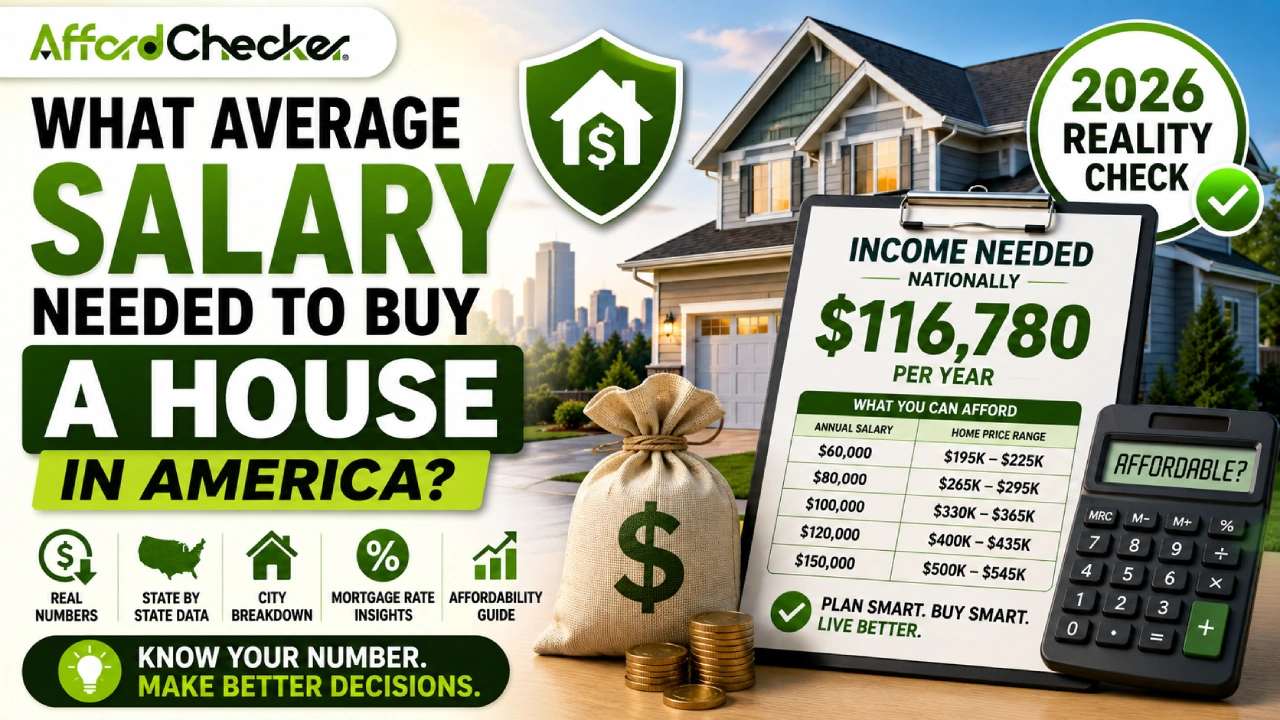
The average American household needs to earn $116,780 per year to comfortably afford a home in the U.S. right now.
That figure comes from a May 2026 Redfin report — and it’s down slightly from the $122,000 peak of mid-2025, which is technically good news. But here’s the problem: the median U.S. household income sits around $88,000. That leaves a gap of nearly $29,000.
Translation: the typical American family is about one full salary short of homeownership.
If you’ve been Googling “what salary do I need to buy a house” and feeling vaguely defeated, this guide is for you. We’re going to break down what different salaries can actually buy, state-by-state numbers, and — most importantly — what you can realistically do about it.
Quick Answer: Salary Needed to Buy a House in 2026
| Metric | 2026 Figure |
|---|---|
| Income needed nationally | ~$116,780/year |
| U.S. median household income | ~$88,000/year |
| Median U.S. home price | ~$418,000 |
| Typical 30-year mortgage rate | ~6.5–7% |
| Income gap (needed vs. median) | ~$28,780 |
| Share of income at median salary | ~40% (vs. the recommended 30%) |
The 30% rule is the standard benchmark: your total monthly housing costs — mortgage, property taxes, and insurance — shouldn’t exceed 30% of your gross income. By that measure, a household earning $88,000 is spending roughly 40% of their income on a median-priced home. That’s considered financially stressful territory.
Why Is the Income Bar So High Right Now?
Three things collided at once — and they haven’t untangled.
Mortgage rates stayed elevated. After hovering near 3% in 2021, rates climbed sharply and have settled into the 6.5–7% range. Every additional percentage point on a $400,000 loan adds roughly $250–$280 per month to your payment.
Home prices held firm. The national median didn’t crash the way many buyers hoped. Limited inventory — especially in desirable suburban and mid-size city markets — kept prices close to their peaks. The typical U.S. property now costs close to $418,000, according to the National Association of Realtors.
Wages rose, but not fast enough. U.S. workers have seen pay increases of about 4% in 2026, which sounds good until you realize carrying costs have outpaced wages in most markets for years.
The result: Redfin found that the median salary isn’t enough to comfortably afford a home in 41 of the 49 most populous U.S. cities.
How Much House Can You Afford by Salary?
This is the table most sites don’t publish — a clear salary-to-home-price guide. These figures assume a 6.75% mortgage rate, 10% down payment, and total housing costs (mortgage + taxes + insurance) at 30% of gross income.
| Annual Salary | Max Monthly Housing Budget | Estimated Affordable Home Price |
|---|---|---|
| $50,000 | ~$1,250/month | ~$160,000–$185,000 |
| $60,000 | ~$1,500/month | ~$195,000–$225,000 |
| $70,000 | ~$1,750/month | ~$230,000–$260,000 |
| $80,000 | ~$2,000/month | ~$265,000–$295,000 |
| $90,000 | ~$2,250/month | ~$300,000–$330,000 |
| $100,000 | ~$2,500/month | ~$330,000–$365,000 |
| $120,000 | ~$3,000/month | ~$400,000–$435,000 |
| $150,000 | ~$3,750/month | ~$500,000–$545,000 |
| $200,000 | ~$5,000/month | ~$665,000–$725,000 |
Key insight: At $100,000 per year, you can just barely afford a home at the national median price — and that’s only if your credit score is solid, your other debts are low, and you’ve saved for a meaningful down payment. At $80,000, you’re looking at markets well below the national median.
The National Housing Affordability Picture: City by City
Most Expensive Cities to Buy In (2026)
Coastal tech hubs and high-demand metros remain brutally unaffordable. In San Francisco, the median sales price hit $1.7 million in March 2026 — largely driven by the AI tech boom pulling high-paid workers into Silicon Valley.
| City | Estimated Annual Income Needed |
|---|---|
| San Francisco, CA | ~$444,000 |
| San Jose, CA | ~$426,000 |
| Los Angeles, CA | $200,000+ |
| New York City, NY | $190,000+ |
| Seattle, WA | $175,000+ |
| Boston, MA | $165,000+ |
| Denver, CO | $160,000+ |
| Miami, FL | $125,000+ |
| Austin, TX | $115,000+ |
These aren’t typos. In San Francisco and San Jose, you’d need to earn more than five times the national median income just to afford the typical home.
Most Affordable Cities to Buy In (2026)
The Midwest is where the math actually works for median earners. Several cities have median home prices well below $250,000 and local incomes that stretch further than national averages suggest.
| City | Income Needed | Local Median Income |
|---|---|---|
| Detroit, MI | ~$56,000 | ~$65,000 |
| Cleveland, OH | ~$63,000 | ~$73,000 |
| Pittsburgh, PA | ~$65,000 | ~$73,000 |
| St. Louis, MO | ~$70,000 | ~$78,000 |
| Cincinnati, OH | ~$81,000 | ~$86,000 |
| Indianapolis, IN | ~$80,000 | ~$86,000 |
| Warren, MI | ~$83,000 | ~$87,000 |
In Detroit, for instance, a household earning the U.S. median income is $9,000 above what they need to afford a home there. That kind of margin is increasingly rare in America.
Salary Needed to Buy a House in Every State
These figures reflect a 30-year fixed mortgage, approximately 10–20% down, and the standard 30% housing cost benchmark. Most recent data reflects late 2024 through mid-2026.
Most Affordable States
| State | Income Needed |
|---|---|
| West Virginia | ~$71,000–$73,000 |
| Ohio | ~$74,000–$75,000 |
| Michigan | ~$76,000–$79,000 |
| Iowa | ~$80,000–$82,000 |
| Louisiana | ~$79,000–$81,000 |
| Indiana | ~$80,000–$82,000 |
| Kansas | ~$80,000–$83,000 |
| Missouri | ~$83,000–$85,000 |
| Arkansas | ~$83,000–$86,000 |
| Mississippi | ~$83,000–$85,000 |
Mid-Range States
| State | Income Needed |
|---|---|
| Illinois | ~$83,000–$86,000 |
| Oklahoma | ~$85,000 |
| Kentucky | ~$86,000–$88,000 |
| Pennsylvania | ~$85,000–$87,000 |
| Alabama | ~$92,000–$94,000 |
| Nebraska | ~$99,000–$100,000 |
| Texas | ~$102,000–$106,000 |
| Georgia | ~$109,000–$114,000 |
| North Carolina | ~$115,000–$117,000 |
| Virginia | ~$117,000–$122,000 |
| Maryland | ~$117,000–$118,000 |
| Florida | ~$125,000–$127,000 |
| Alaska | ~$121,000–$122,000 |
| Tennessee | ~$121,000–$125,000 |
Most Expensive States
| State | Income Needed |
|---|---|
| Arizona | ~$140,000–$141,000 |
| Nevada | ~$140,000–$142,000 |
| Delaware | ~$138,000–$141,000 |
| New Jersey | ~$157,000–$160,000 |
| Oregon | ~$158,000–$162,000 |
| Idaho | ~$163,000–$165,000 |
| New Hampshire | ~$165,000–$166,000 |
| Colorado | ~$161,000–$166,000 |
| Utah | ~$168,000–$174,000 |
| Washington | ~$174,000–$177,000 |
| Montana | ~$176,000–$178,000 |
| New York | ~$189,000–$190,000 |
| California | ~$210,000 |
| Massachusetts | ~$215,000–$216,000 |
| Hawaii | ~$229,000–$236,000 |
Hawaii remains the single most expensive state — requiring income nearly 160% above its own median to afford the typical home.
Real-World Salary Scenarios: What Does Your Paycheck Actually Buy?
🏠 Scenario 1 — $60,000/Year in Ohio
Profile: Single professional, $60K salary, $5,000 in savings, $300/month car payment
- Gross monthly income: $5,000
- 30% housing budget: $1,500/month
- Property taxes + insurance (Ohio average): ~$380/month
- Available for mortgage P&I: ~$1,120
- Affordable home price range: ~$185,000–$205,000
What this looks like in practice: A $190,000 home in Cleveland or Dayton with a 3.5% FHA down payment (~$6,650) results in a total monthly payment of roughly $1,450–$1,500. Tight, but achievable. Ohio remains one of the few states where this math works for a single median earner.
Watch out for: FHA loans require mortgage insurance premiums (MIP) for the life of the loan unless you refinance. Factor in an extra $120–$150/month.
🏠 Scenario 2 — $80,000/Year in Texas
Profile: Single earner, $80K salary, $15,000 in savings, $400/month in debts
- Gross monthly income: $6,667
- 30% housing budget: $2,000/month
- Property taxes + insurance (TX property taxes average 1.6–2%/year): ~$600–$700/month
- Available for mortgage P&I: ~$1,300–$1,400
- Affordable home price range: ~$210,000–$240,000
What this looks like in practice: Texas looks more affordable than it is on paper. Property taxes in suburban Houston or DFW can easily run $400–$550/month on a $240,000 home — eating a massive chunk of your housing budget. San Antonio and Lubbock suburbs are your best bets in this range.
Watch out for: Texas has no state income tax, which helps take-home pay — but property tax rates among the highest in the nation offset that benefit significantly for homeowners.
🏠 Scenario 3 — $100,000/Year in North Carolina
Profile: Tech professional, $100K salary, $25,000 saved, $300/month in debts
- Gross monthly income: $8,333
- 30% housing budget: $2,500/month
- Property taxes + insurance: ~$500/month
- Available for mortgage P&I: ~$2,000
- Affordable home price range: ~$295,000–$325,000
What this looks like in practice: Raleigh and Charlotte now require $115,000–$130,000 to afford the median home. At $100K, look at Greensboro, Winston-Salem, Fayetteville, or outer suburban rings. You have real options — just not the trendy neighborhoods you might want.
Watch out for: NC has seen some of the fastest home price appreciation in the Southeast over the past four years. Prices in Raleigh have nearly doubled since 2019.
🏠 Scenario 4 — Dual Income at $120,000 Combined
Profile: Couple with combined $120K (e.g., $65K + $55K), $35,000 saved, $600/month in combined debts
- Combined gross monthly income: $10,000
- 30% housing budget: $3,000/month
- Property taxes + insurance: ~$600/month
- Available for mortgage P&I: ~$2,400
- Affordable home price range: ~$355,000–$400,000
What this looks like in practice: This is the scenario where the national median home becomes accessible — barely. Combined income unlocks the most Midwest markets, suburban South, and smaller coastal cities. The risk is one income stream disappearing.
Watch out for: Keep individual debts low before combining finances for a mortgage. If each partner carries $400/month in student loans and car payments, total debt is $800/month — pushing total DTI dangerously close to 36%, which is the lender limit.
The Hidden Costs That Blow Most Housing Budgets
Your mortgage payment is the headline number — but it’s never the real number. Here’s what full monthly ownership actually looks like on a $400,000 home:
| Cost Item | Monthly Estimate |
|---|---|
| Mortgage principal & interest | $2,300–$2,500 |
| Property taxes | $300–$650 |
| Homeowner’s insurance | $150–$300 |
| PMI (if less than 20% down) | $100–$300 |
| HOA fees (if applicable) | $0–$400 |
| Maintenance reserve (1% of home/yr) | ~$333 |
| Real monthly total | $3,183–$4,483 |
To afford $3,800/month in total costs while staying under 30% of income? You’d need to earn around $152,000/year. Not $116,000.
This is what most affordability calculators miss — and why so many buyers feel house-poor within their first year.
The insurance crisis is making this worse. Homeowner’s insurance premiums have surged in climate-vulnerable states. In parts of Louisiana and Florida, annual premiums on a $400,000 home can reach $6,000–$10,000 — adding $500–$833/month before you’ve made a single mortgage payment. Factor this in before you fall in love with a home in a flood zone or fire corridor.
Pros and Cons of Buying at Your Maximum Budget
Why Buying Now Still Makes Sense
- Your payment stays fixed. Rent keeps rising; a 30-year fixed mortgage doesn’t. The $2,400 payment you lock in today will feel much smaller in 2035.
- You build equity instead of paying someone else’s mortgage. Every principal payment goes toward your net worth.
- Tax advantages remain. Mortgage interest and property taxes may be deductible depending on your situation.
- Stability has real financial value. No surprise lease terminations, landlord sell-offs, or rent hikes mid-year.
- Wealth gap. According to the Federal Reserve, the median net worth of homeowners is roughly 40 times that of renters.
❌ Why Stretching Too Far Is Dangerous
- Zero margin for error. One job loss, medical bill, or major repair can push you into financial crisis.
- Carrying costs keep rising. Insurance, property taxes, and maintenance can increase faster than you planned.
- You lose financial flexibility. Money locked in a home equity isn’t in your emergency fund, retirement account, or investment portfolio.
- Market downturns happen. Buying at the top of your budget in an overheated market can leave you underwater if values correct.
- Stress compounds everything. Financial strain has very real effects on health, relationships, and work performance.
Smart Recommendations: Buying a House on a Tight Salary
These aren’t generic tips. They’re the moves that actually work.
Use the 28/36 rule — not just the 30% rule. Most lenders care about two ratios: housing costs under 28% of gross income, and all monthly debts (mortgage + car + student loans) under 36%. If you’re already at 25% of income in non-housing debt, adding a mortgage pushes you into denial territory. Know your DTI before you look at a single listing.
Target homes 20–25% below your maximum. If you qualify for $350,000, look seriously in the $270,000–$290,000 range. That buffer covers property tax increases, insurance hikes, and the $8,000 HVAC replacement you didn’t see coming.
Build your emergency fund before closing — not from your down payment. The worst financial position is closing on a house and having $1,200 left in the bank. Aim for 3–6 months of expenses after closing costs and down payment are paid.
Credit score first, house second. The difference between a 680 and a 740 credit score typically translates to a 0.5–0.75% lower mortgage rate. On a $300,000 loan, that’s $90–$135/month — or $32,000–$48,000 over 30 years. Spend six months building your score before applying.
Consider a market shift before a lifestyle shift. If remote work is an option, relocating from Charlotte to Cleveland, or from Phoenix to Pittsburgh, can cut your required income threshold by 40–60%. That’s more powerful than any savings plan.
Alternative Options If You’re Not There Yet
You don’t need a $116,000 salary to become a homeowner. Here are legitimate paths that work:
FHA Loans The Federal Housing Administration backs loans with as little as 3.5% down and credit scores starting at 580. This dramatically lowers the entry barrier. The trade-off is mortgage insurance premium (MIP), which stays for the life of the loan unless you later refinance into a conventional mortgage.
VA Loans For veterans and active-duty service members, VA loans offer zero down payment, no PMI, and competitive interest rates. This is one of the best financial tools available to those who qualify — if you’ve served, use it.
USDA Loans Available in qualifying rural and suburban areas, USDA loans require no down payment and offer below-market rates. More areas qualify than most people expect — check the USDA eligibility map at usda.gov. Income limits apply, but they’re generous for moderate earners.
Down Payment Assistance Programs Every state has programs through its Housing Finance Agency offering grants, forgivable loans, or below-market second mortgages to help cover down payments and closing costs. Many programs are available to repeat buyers, not just first-timers. Google “[your state] housing finance agency down payment assistance” to find what’s available.
Assumable Mortgages A growing strategy: finding a home where you can take over the seller’s existing loan — sometimes at a rate of 3–4.5% from 2020–2022. On a $300,000 balance, that could save you $400–$600/month compared to taking a new loan at today’s rates. Only FHA, VA, and USDA loans are assumable, and the seller has to agree — but the savings can be life-changing.
Co-Buying with Family or a Partner Combining incomes to qualify is increasingly common — and increasingly necessary. If your sibling, parent, or close friend is also priced out of homeownership, a legal co-ownership agreement lets both parties build equity while sharing costs. Get an attorney to draft a clear agreement before signing anything.
Frequently Asked Questions
Based on Redfin’s May 2026 data, U.S. households need to earn approximately $116,780 per year to comfortably afford the median-priced home, which costs around $418,000. This assumes roughly 30% of income going toward housing costs.
Yes — in certain markets. At $60,000/year, you can realistically afford a home priced between $185,000 and $225,000. States like Ohio, Michigan, West Virginia, Iowa, Indiana, and parts of the South and Midwest have markets where this works.
Using a 6.75% rate, 10% down, and average taxes/insurance, you’d need to earn roughly $110,000–$125,000 per year to keep a $400,000 home within the 30% guideline. Your actual number depends heavily on local property tax rates and insurance costs.
The 28/36 rule says housing costs shouldn’t exceed 28% of gross income, and total monthly debt payments shouldn’t exceed 36%. Most lenders use this as a guideline when evaluating applications. If your total debts are already 20%+ of income, your mortgage eligibility shrinks significantly.
Beyond your down payment (3–20% of purchase price), budget for closing costs (2–5%), a 3–6 month emergency fund after closing, and immediate move-in expenses. For a $300,000 home, you want at least $25,000–$50,000 in savings depending on your loan type.
Final Verdict
Here’s the honest truth: the average American is currently priced out of the average American home.
A $116,780 income requirement against an $88,000 median wage is a genuine affordability crisis — not a temporary blip. More than 8 in 10 Americans say it’s harder to buy a home today than it was for earlier generations, according to a February CBS News poll. They’re right.
But this isn’t the end of the story. It’s a map of the problem.
If you earn close to the median, the path to homeownership runs through affordable states and smaller cities — not through hoping coastal markets crash. It runs through eliminating debt, building credit, and targeting a price range with real margin. It runs through programs like FHA, USDA, and VA that exist precisely because the conventional market leaves most Americans behind.
The homeownership gap is real. So is your ability to close it — if you focus on the variables you can actually control.
Know your number. Build toward it. And recognize that a $200,000 home in Cleveland builds the same equity as a $700,000 home in Austin — just with a lot less financial stress along the way.