You found an apartment you actually like. Good layout, decent neighborhood, in-unit laundry. Then you do the math and the number makes your stomach drop.
That feeling isn’t you being bad with money. It’s the market telling you something real: the classic rent advice Americans have followed for decades no longer lines up with what apartments actually cost in 2026.
According to U.S. household data, the median American renting household now pays roughly 33% of income on rent, already above the famous 30% rule. And in cities like New York, Austin, Miami, or Seattle, that number climbs even higher.
So which budget rule should you actually follow? The answer depends on your income level, city, debt load, and financial goals. This guide breaks all of it down clearly, with real numbers.
Quick Answer
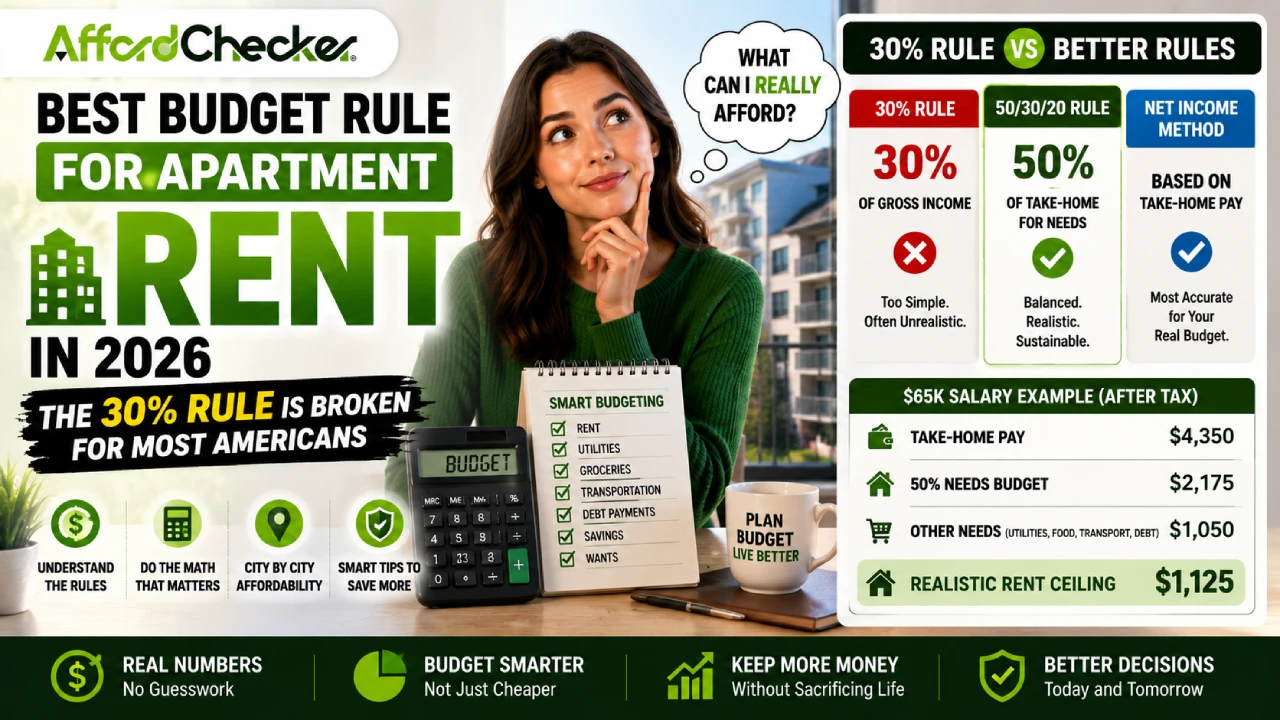
The 30% rule (spend no more than 30% of gross income on rent) is the most widely used guideline, but it’s too simplistic for 2026. A better approach is the 50/30/20 rule, where rent falls inside a 50% “needs” bucket alongside utilities, groceries, and debt payments. For high-cost cities or lower incomes, a net income method — starting from take-home pay rather than gross — is the most accurate tool.
The rule that works best for you depends on where you live and what else your budget is carrying.
What Is the 30% Rent Rule?
The 30% rule originated in U.S. public housing policy in the 1960s and 1970s. Federal guidelines originally used 25% of income as the affordability threshold, then revised it upward to 30%. Over time, that number became general personal finance advice for renters everywhere.
The formula is simple: take your gross monthly income, multiply by 0.30, and that’s your rent ceiling.
30% Rule Examples (Gross Income)
| Annual Salary | Monthly Gross | 30% Rent Max |
|---|---|---|
| $35,000 | $2,917 | $875 |
| $50,000 | $4,167 | $1,250 |
| $60,000 | $5,000 | $1,500 |
| $75,000 | $6,250 | $1,875 |
| $90,000 | $7,500 | $2,250 |
| $100,000 | $8,333 | $2,500 |
| $120,000 | $10,000 | $3,000 |
That math looks clean. The problem is that gross income is what you earn, not what you actually have to spend.
Does the 30% Rule Still Work in 2026?
For some people, yes. For a lot of Americans right now, not really.
Here’s why it breaks down.
Gross vs. net is a massive gap. A person earning $60,000 in Texas takes home roughly $4,100 per month after federal taxes and FICA. The 30% rule gives them a $1,500 rent ceiling based on gross. But $1,500 out of $4,100 take-home is actually 36.5% of what they can actually spend. That’s already into financially stretched territory.
Debt changes everything. If that same person has a $350 car payment, $250 in student loan minimums, and $150 in credit card minimums, they’re burning $750/month before rent, groceries, utilities, or a single other bill. A $1,500 apartment suddenly leaves very little room.
Rents in most major markets exceed what the rule allows. The national median one-bedroom apartment rent was approximately $1,500–$1,700 in major metro areas heading into 2026. For someone earning $50,000/year, that already pushes past the 30% line.
The 30% rule is still useful as a quick screening tool when you’re browsing listings. Just don’t treat it as a financial plan.
The 50/30/20 Rule: A Smarter Starting Point
The 50/30/20 framework gives rent a more realistic home in your budget. Instead of one isolated rent number, it looks at your full financial picture.
- 50% of net (take-home) income → Needs: rent, utilities, groceries, transportation, insurance, minimum debt payments
- 30% of net income → Wants: dining out, subscriptions, entertainment, travel
- 20% of net income → Savings/Debt: emergency fund, retirement, extra debt payoff
Under this model, rent sits inside the 50% needs bucket — not as the only thing in it.
How to calculate your real rent ceiling with 50/30/20:
- Start with your monthly take-home pay (after taxes, not gross)
- Multiply by 50% — this is your total needs budget
- Subtract your other fixed needs: utilities (~$150–$250), groceries (~$300–$500), transportation (~$200–$400), insurance, and debt minimums
- What’s left is your realistic rent ceiling
Real Example — $65,000 Salary in Dallas, TX
- Gross monthly: $5,417
- Estimated take-home: ~$4,350/month
- 50% needs budget: $2,175
- Other monthly needs (utilities + groceries + car + insurance + student loan min): ~$1,050
- Realistic rent ceiling: ~$1,125
The 30% rule would have pointed to $1,625 using gross income. That $500 gap is significant. Committing to $1,625 rent on this budget means something else — savings, debt payoff, or emergency fund — takes the hit.
50/30/20 Rent Ceiling by Income (After-Tax Method)
This table uses realistic average tax burdens for single filers in mid-cost states. Adjust for your specific location and tax situation.
| Annual Salary | Est. Monthly Take-Home | 50% Needs Budget | Est. Other Needs | Realistic Rent Ceiling |
|---|---|---|---|---|
| $35,000 | ~$2,600 | $1,300 | ~$700 | ~$600 |
| $45,000 | ~$3,200 | $1,600 | ~$800 | ~$800 |
| $55,000 | ~$3,800 | $1,900 | ~$900 | ~$1,000 |
| $65,000 | ~$4,350 | $2,175 | ~$1,050 | ~$1,125 |
| $75,000 | ~$4,900 | $2,450 | ~$1,100 | ~$1,350 |
| $90,000 | ~$5,700 | $2,850 | ~$1,150 | ~$1,700 |
| $100,000 | ~$6,200 | $3,100 | ~$1,200 | ~$1,900 |
| $120,000 | ~$7,200 | $3,600 | ~$1,300 | ~$2,300 |
Other needs estimated at average expenses for a single renter: utilities, groceries, basic transportation, renters insurance, and any minimum debt payments. Your actual number varies.
Which Budget Rule Is Best for Your Situation?
Different rules fit different financial profiles. Here’s a direct comparison.
30% Rule — Best for:
- Quick apartment screening (before you crunch full numbers)
- Renters with low or no debt and stable income
- Landlord qualification checks (many use 3× monthly rent as income requirement)
- Higher earners in low-cost states
50/30/20 Rule — Best for:
- Anyone carrying existing debt (student loans, auto, credit cards)
- Renters who want to actively save while renting
- Dual-income households where combined income looks good but individual costs are high
- People who want a complete monthly budget, not just a rent number
Net Income Method — Best for:
- Variable income earners (freelancers, gig workers, commission-based)
- Anyone in a high-tax state (California, New York, New Jersey)
- Renters in high-cost cities where gross income and take-home pay are farthest apart
- Anyone who’s been burned by budgeting to gross income before
The “Floor” Rule (20% of gross) — Best for:
- Aggressive savers trying to build wealth fast
- People with heavy existing debt who need room to pay it down
- Anyone saving for a down payment while renting
What Counts as Your True Rent Cost?
One of the most common apartment budgeting mistakes is treating the listed rent as the full cost. It rarely is.
Your total housing cost typically includes:
- Base rent — the lease amount
- Utilities — electric, gas, water (often $100–$250/month depending on region and unit size)
- Internet — $50–$90/month
- Renters insurance — $12–$25/month (always carry this)
- Parking — $50–$250/month in urban areas, sometimes free in suburbs
- Pet fees — $25–$75/month if applicable
- Storage or amenity fees — varies by building
When comparing apartments, always calculate the total monthly housing cost, not just rent. A $1,400 apartment with $300 in utilities and $100 parking costs $1,800. A $1,600 apartment with utilities included and free parking costs $1,650. The cheaper-looking unit isn’t always cheaper.
2026 Apartment Rent Reality Check by City
To apply any budget rule realistically, you need to know what rent actually looks like in your market. Here’s a general picture of 2026 median one-bedroom rents in major U.S. cities:
| City | Est. 1BR Median Rent | Salary Needed (30% Rule) | Salary Needed (50/30/20 net) |
|---|---|---|---|
| New York, NY | ~$3,400 | $136,000/year | $150,000+/year |
| San Francisco, CA | ~$3,100 | $124,000/year | $135,000+/year |
| Boston, MA | ~$2,900 | $116,000/year | $125,000+/year |
| Miami, FL | ~$2,400 | $96,000/year | $105,000+/year |
| Seattle, WA | ~$2,200 | $88,000/year | $95,000+/year |
| Denver, CO | ~$1,900 | $76,000/year | $83,000+/year |
| Chicago, IL | ~$1,800 | $72,000/year | $79,000+/year |
| Austin, TX | ~$1,600 | $64,000/year | $70,000+/year |
| Phoenix, AZ | ~$1,450 | $58,000/year | $63,000+/year |
| Atlanta, GA | ~$1,500 | $60,000/year | $66,000+/year |
| Dallas, TX | ~$1,400 | $56,000/year | $61,000+/year |
| Columbus, OH | ~$1,100 | $44,000/year | $48,000+/year |
The “50/30/20 net” column runs higher because it accounts for taxes reducing your actual take-home pay, which the gross-income 30% rule ignores.
What Happens If You’re Already Over the Line?
If you’re currently paying more than 30% of your gross income on rent, you’re technically “rent-burdened” by the federal HUD definition. If you’re paying more than 50%, you’re “severely cost-burdened.”
You’re not alone. Tens of millions of American renters fall into one of these categories.
Being rent-burdened isn’t necessarily a crisis, but it does mean something else in your budget needs to give. Most often, that’s:
- Emergency savings (the most dangerous trade-off)
- Retirement contributions
- Debt payoff speed
- Day-to-day discretionary spending
If you’re over 35–40% of gross income on rent and struggling to save anything, here are your realistic options:
1. Reduce rent directly
- Get a roommate (splitting a 2BR often saves $400–$700/month vs. a 1BR)
- Move to a less central neighborhood with transit access
- Downsize unit size (studio vs. 1BR can save $200–$400/month in most markets)
- Negotiate at lease renewal, especially if you’ve been a reliable tenant
2. Reduce other costs to compensate
- Eliminate or pause subscriptions
- Restructure transportation (public transit vs. car ownership)
- Refinance or income-drive student loan payments
- Shop renters insurance annually — rates vary more than most people realize
3. Increase income
- Even $300–$500/month from a side income source meaningfully changes your 30% calculation
- A $5,000 annual raise lowers your rent-to-income ratio by about 2–3 percentage points
4. Plan your exit
- If your market is genuinely unaffordable for your income, it may be worth a geographic move
- Cities like Columbus, Indianapolis, Memphis, Raleigh, and San Antonio have seen strong job growth with substantially lower rent-to-income ratios
5 Smart Strategies to Maximize Apartment Affordability
1. Know your “range,” not just your “max”
Don’t go into an apartment search with a single number. Build a range:
- Comfortable rent: Leaves breathing room in your budget
- Stretch rent: Works if income is stable and other costs are predictable
- Hard limit: Anything above this creates real financial stress
2. Lock in longer leases when rent feels right
In markets where rents are rising, a 24-month lease at a fair price is worth considering. Locking in today’s rate protects you from increases during the lease term.
3. Budget for move-in separately
Move-in costs — security deposit (usually 1–2 months rent), first and last month, application fees, moving expenses — often run $4,000–$8,000 or more. Keep this separate from your monthly budget and save for it in advance.
4. Build your credit before you hunt
Most landlords pull credit for apartment applications. A score below 650 can mean rejection or a co-signer requirement. A score above 720 puts you in the best negotiating position and occasionally unlocks better lease terms.
5. Factor in commute cost, not just rent
An apartment $200 cheaper per month that adds $180 in monthly gas, tolls, or transit costs has saved you $20. Always evaluate apartments on total cost-to-live, including transportation.
Pros and Cons of Each Budget Rule
| Rule | Pros | Cons |
|---|---|---|
| 30% of Gross | Simple, fast, matches landlord income requirements | Ignores taxes, debt, savings goals; overestimates actual budget room |
| 50/30/20 (Net) | Holistic, accounts for full financial picture | More complex; requires knowing all monthly expenses upfront |
| Net Income 30% | Most accurate for take-home pay reality | Landlords don’t use it; may qualify you for apartments beyond your true limit |
| 20% “Floor” Rule | Maximum savings potential | Very restrictive; only realistic in low-cost markets or high incomes |
Smart Recommendation
For most renters in 2026, the best approach is a two-step method:
Step 1: Use the 30% gross income rule as your initial search filter. This tells you what landlords will likely approve you for and gives you a fast range when browsing listings.
Step 2: Run the 50/30/20 calculation using your actual after-tax income. List your real monthly needs — debt minimums, transportation, groceries, utilities — and see how much room is genuinely left for rent. If this number is lower than the 30% figure, use the lower one.
The number that protects your savings and debt payoff goals is the right number.
Alternatives When Rent Takes Too Much
If your income and local rents simply don’t line up, renting doesn’t have to be all-or-nothing:
- Co-living spaces: Furnished rooms in shared homes, often $700–$1,200/month in cities where studios cost twice that
- Month-to-month rentals: More flexibility while you increase income or wait for a better opportunity
- Moving to a secondary market: Cities within commuting distance of expensive metros often offer 30–40% lower rents
- Moving in with family temporarily: Used strategically, even 6 months can allow meaningful savings to change your financial position
Frequently Asked Questions
Start with gross to screen listings (landlords use gross). Use net — your actual take-home — to verify the rent fits your real monthly life. If rent looks affordable on gross but not on net, you’ll feel that pressure every month.
In many U.S. markets, no. The national median renter already pays above 30% of income on rent. In high-cost cities, 35–40% is the reality for average earners. The question isn’t whether 30% is ideal — it is — it’s whether your market and income allow it.
Most financial advisors draw a hard line at 40% of gross income as an absolute maximum, and only for people with stable income, no significant debt, and consistent savings habits. Above 40%, financial stress tends to compound quickly.
For budgeting purposes, your “housing cost” should include all utilities you pay. This gives you a true picture of what the apartment costs to live in, not just what you owe the landlord.
Most landlords require gross monthly income to be at least 3× the monthly rent. So a $1,600 apartment requires $4,800/month gross income, or about $57,600/year. Some use 2.5× in competitive markets.
Final Verdict
The “best” budget rule for apartment rent in 2026 isn’t a single number — it’s a method.
Use the 30% rule to filter listings quickly and understand what landlords expect to see on your application. Then run the 50/30/20 calculation on your take-home pay to confirm the rent doesn’t crowd out your savings, debt management, or other financial goals.
If the two numbers conflict — and in many cities at average incomes, they will — trust the take-home calculation. A rent that technically qualifies you on paper but strains your actual budget every month isn’t a win.
The best apartment for your finances is the one you can pay comfortably, save consistently, and live without financial anxiety in — not the nicest one you can barely afford.