The Honest Answer First
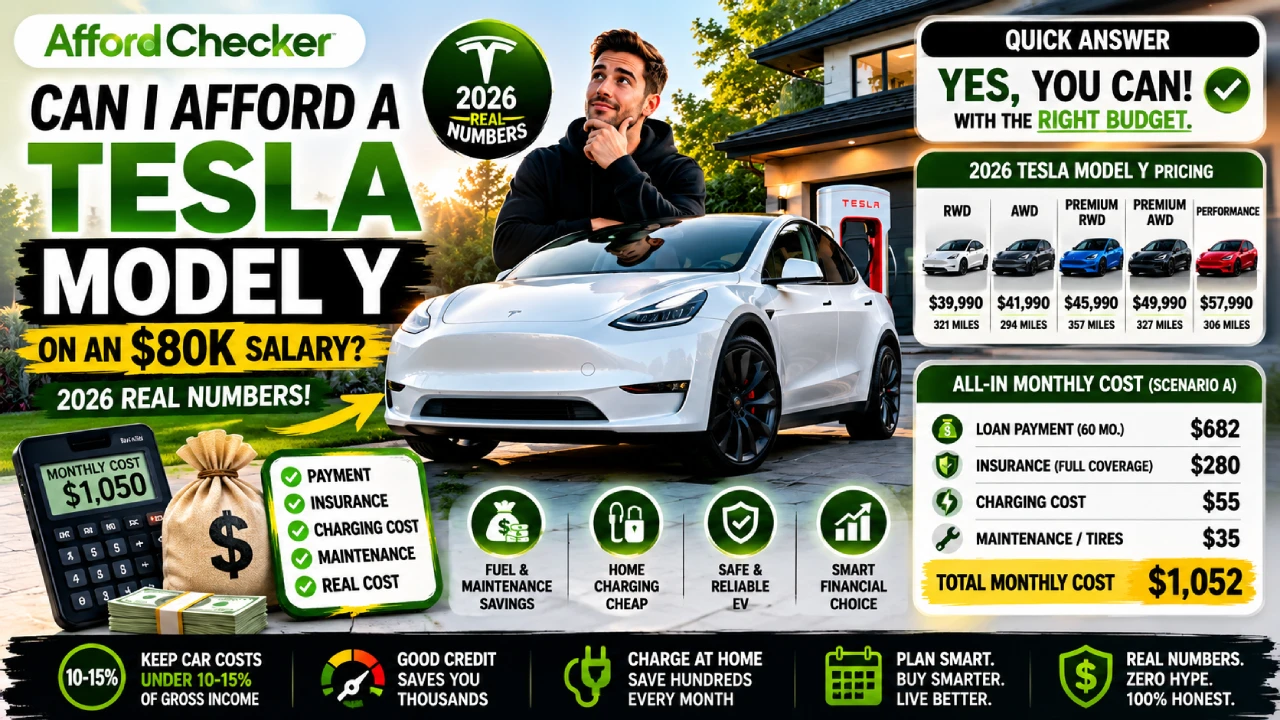
Yes — with conditions. On an $80,000 salary, you can technically afford the base Tesla Model Y, but you’ll be working right at the edge of standard affordability guidelines. Total all-in monthly costs land around $950–$1,100, which is 14–16% of your gross income. That’s right at or just above what most financial advisors consider the safe ceiling.
The Premium or Performance trims? Those push well past the 15% mark and are more realistically a $90,000–$100,000+ income purchase.
Let’s break down the full picture so you can make an actual decision, not just a payment decision.
Tesla Model Y 2026 Pricing: What You’re Paying Right Now
Before we get to salary math, you need to know the current prices — and one thing most articles won’t tell you upfront:
The $7,500 federal EV tax credit is gone. It expired September 30, 2025, under the One Big Beautiful Bill Act. As of 2026, there is no federal purchase rebate on any new Tesla. What you see is what you pay.
Here’s the current 2026 Tesla Model Y lineup in the U.S.:
| Trim | MSRP | Range |
|---|---|---|
| Model Y RWD | $39,990 | 321 miles |
| Model Y AWD | $41,990 | 294 miles |
| Model Y Premium RWD | $45,990 | 357 miles |
| Model Y Premium AWD | $49,990 | 327 miles |
| Model Y Performance | $57,990 | 306 miles |
Add $1,640 for mandatory destination and order fees. Then add sales tax (typically 6–10% depending on your state) and registration, title, and doc fees (another $400–$900 in most states). By the time you’ve actually purchased the car, expect the real all-in cost to run $3,500–$6,000 above sticker price.
The base RWD realistically lands at $43,000–$44,500 after everything. The Premium RWD clears $49,000 easily. The Performance hits $63,000+ on the road.
What $80K Actually Pays You Every Month
Most affordability guides stop at gross income. That’s not what lands in your bank account. Here’s the real take-home on $80,000/year:
Texas, Florida, Nevada (no state income tax):
~$5,350–$5,450/month after federal taxes and FICA
Average state (Ohio, Georgia, Illinois, Virginia):
~$5,000–$5,150/month
California:
~$4,900–$5,000/month after federal and California state income tax
For this analysis, we’ll use $5,150/month as a realistic national midpoint for most working Americans.
That’s the number your budget actually runs on.
The Affordability Rules — Applied to Tesla Model Y
Two rules dominate personal finance car buying advice:
The 10–15% Rule: Keep all car expenses — loan payment, insurance, and fuel — between 10% and 15% of gross income.
- 10% of $80K = $667/month all-in
- 15% of $80K = $1,000/month all-in
The 7% Loan Payment Rule: Your monthly loan payment alone should stay under 7% of gross monthly income.
- 7% of $6,667 (monthly gross) = $467/month for the payment only
That’s the conservative guardrail. Lenders will approve you for far more. That doesn’t make it smart.
Real Monthly Loan Payments: Three Scenarios
Current average auto loan rate for a 60-month new car loan sits at 6.98% APR as of June 2026, according to Bankrate’s weekly survey. Good credit (720+ FICO) can get you into the 5.5–6.5% range.
Here are three realistic purchase scenarios:
The Smart Stretch (Base RWD, 20% Down) – Scenario A
- All-in purchase price: ~$43,500
- Down payment: $8,700 (20%)
- Amount financed: $34,800
- Rate: 6.5% APR, 60 months
- Monthly payment: ~$682
Most Popular Trim (Premium RWD, 15% Down) – Scenario B
- All-in purchase price: ~$49,500
- Down payment: $7,500 (15%)
- Amount financed: $42,000
- Rate: 6.98% APR, 60 months
- Monthly payment: ~$831
Premium AWD, Minimal Down – Scenario C
- All-in purchase price: ~$54,000
- Down payment: $5,400 (10%)
- Amount financed: $48,600
- Rate: 7.5% APR, 60 months
- Monthly payment: ~$975
None of these include insurance. That’s where a lot of budgets collapse.
Tesla Insurance Is More Expensive Than You Think
This is the number that catches most buyers off guard, and it’s a bigger deal on Tesla than almost any other vehicle.
Average full coverage cost for a 2026 Tesla Model Y:
- Typical 30–45 year old, clean driving record, mid-cost state: $250–$320/month
- Best case (aggressive shopping, Tesla Insurance where available): $170–$200/month
- Worst case (younger driver, high-cost city like New York or LA): $400–$600/month
For comparison, a Toyota RAV4 of similar price runs about $135–$175/month for full coverage.
Why is Tesla so expensive to insure? A few real reasons:
- Proprietary parts — only Tesla-certified shops can work on the car
- Camera and sensor recalibration after even minor collisions adds $1,500–$3,000 to repair bills
- Repair labor rates at certified shops hit $305/hour
- Limited shop availability means longer repair times and less pricing competition
The Reddit post you may have seen about an $1,100/month insurance quote is an outlier, but $300/month is genuinely the average. Budget accordingly.
For this analysis, we’ll use a realistic $280/month for a 35-year-old with a clean record in a typical state.
Full Monthly Cost: What $80K Really Looks Like
Let’s stack up Scenario A — the most affordable real-world purchase — with every true ownership cost:
| Cost Item | Monthly |
|---|---|
| Loan payment (RWD, 20% down, 6.5% / 60 mo.) | $682 |
| Full coverage insurance | $280 |
| Home charging (15K miles/yr at $0.15/kWh avg) | $55 |
| Maintenance reserve (tires, wiper blades, annual) | $35 |
| Total monthly cost | $1,052 |
That’s 15.8% of $80K gross income. Just above the 15% ceiling.
As a percentage of take-home ($5,150/month): about 20.4% — which is where some financial counselors start to get concerned.
Workable? Yes. Comfortable? Tight, especially if you’re also carrying rent above $1,500/month or any student loan debt.
The EV Savings: Real, But Don’t Let Them Justify a Stretch
Tesla owners will correctly point out that they save money on fuel and maintenance. Here’s what that actually looks like:
Fuel savings driving 15,000 miles per year:
- Average gas SUV (28 MPG at $3.50/gallon): ~$156/month
- Tesla Model Y (3.5 miles per kWh, $0.15/kWh at home): ~$54/month
- Monthly fuel savings: ~$102
Maintenance savings: No oil changes. Regenerative braking means less brake wear. Fewer fluids to replace. Tesla’s annual maintenance runs roughly $400–$500/year vs. $700–$900 for most comparable gas SUVs.
- Monthly savings: ~$25–$35
Total monthly savings vs. average gas SUV: ~$125–$135/month
That’s genuine money. Over five years it’s roughly $8,000–$10,000 back in your pocket.
The honest caveat: insurance costs wipe out most of that savings compared to a similarly priced RAV4 or CR-V. The true advantage of the Tesla shows up against vehicles with worse fuel economy — not against other efficient cars.
How It Looks in Different States
Texas ($80K, No State Income Tax)
Take-home: ~$5,400/month
Model Y RWD all-in monthly cost: ~$1,052
Percentage of take-home: ~19.5%
Verdict: Manageable, but leaves thin margin for building savings.
California ($80K, High State Tax)
Take-home: ~$4,950/month
Model Y RWD all-in monthly cost: ~$1,100–$1,150 (electricity costs ~$0.28/kWh avg, so charging runs $100+ not $55)
Percentage of take-home: ~22–23%
Verdict: This is genuinely tight. California electricity rates make EV ownership more expensive than the national average. Factor that into your numbers before assuming the gas savings apply.
New York City ($80K)
Take-home: ~$4,800/month (NYC adds local income tax on top of state)
Insurance potentially $400–$500/month
Verdict: A $80K salary in NYC is a lean budget as it is. The Model Y would consume nearly 25% of take-home pay. Worth waiting until income hits $95,000+.
Should You Lease Instead?
Leasing a Model Y can lower your monthly number meaningfully. Typical 2026 Model Y RWD lease terms run roughly $429–$499/month for 36 months with 10,000 miles/year — typically requiring $3,000–$4,500 capitalized cost reduction (upfront payment) at signing.
That’s $200–$250 less per month than buying, which helps the affordability math considerably. The downsides: you build no equity, mileage overages cost $0.25–$0.30/mile, and you’re locked into the vehicle for the lease term.
There is no federal leasing incentive in 2026 the way there was under the old Inflation Reduction Act. Evaluate leasing purely on cash flow, not on phantom tax savings.
Leasing makes sense if:
- You drive under 10,000–12,000 miles per year
- You like having a new car every 3 years
- The lower payment meaningfully improves your monthly budget picture
Buying makes more sense if:
- You drive heavily (over 12,000 miles/year)
- You plan to keep the car 6–8 years and want to eventually be payment-free
- You want to build equity in the asset
Pros and Cons at $80K Salary
Pros
- Base trim RWD is within reach with the right down payment and credit
- ~$1,200–$1,600/year in fuel savings vs. most gas SUVs
- NHTSA 5-star safety rating, IIHS Top Safety Pick+ — genuinely among the safest SUVs in its class
- Strong resale value historically, though EV resale has softened as competition increased
- Autopilot and over-the-air updates come standard across all trims
- Single-pedal driving, home charging convenience — real quality-of-life upgrades
Cons
- No federal tax credit — you’re paying full price with no rebate
- Insurance runs $140–$180/month more than comparable ICE vehicles
- Tesla repair shops are genuinely scarce — wait times for body work can run 6–10 weeks in some markets
- Parts are proprietary; you can’t use independent shops without voiding coverage
- Premium and Performance trims require $90,000–$100,000+ income to own without real budget stress
- The base AWD has the shortest range (294 miles) of any current Model Y trim — worth knowing before you commit
Smart Recommendations by Situation
Buy the Model Y RWD if: Your monthly non-housing debts total under $300 (minimal student loans, no credit card balances), you can put $8,000+ down, you shop insurance with at least 4 carriers and land under $250/month, and your rent or mortgage is under $1,700/month.
Hold off or look at alternatives if: You’re carrying more than $500/month in existing debt payments, your down payment is under $5,000, your credit score is below 700 (you’ll get 7.5–8.5% APR and the payment math gets worse fast), or you’re in a high-insurance state with no good Tesla Insurance option.
Upgrade to Premium when income hits $90K+: With an extra $10,000–$15,000 in annual gross income, the Premium RWD’s $831/month payment drops to 11% of gross, well inside the comfort zone.
Alternative Vehicles That Fit Better at $80K
If the numbers don’t work cleanly right now, these are genuinely good alternatives:
Chevy Equinox EV — Starting around $34,995
Longer EPA range than the base Model Y AWD (350+ miles), lower insurance costs, more dealer availability for repairs. Much more budget-friendly if insurance is your constraint.
Hyundai Ioniq 5 — Starting around $42,450
800-volt architecture means it charges from 10–80% in about 18 minutes. Strong technology, distinct styling, and insurance rates typically run $60–$80/month less than the Model Y on the same driver profile.
Used 2022–2023 Tesla Model Y — $32,000–$38,000
All the Tesla software and Autopilot experience. Lower insurance (a 2022 model is significantly cheaper to insure than a 2026). The trade-off is fewer features (no light bar, older camera setup, smaller screen) and a shorter remaining warranty window.
Kia EV6 — Starting around $42,600
Same platform as the Ioniq 5. More performance-oriented feel. Worth a look if you want the EV driving experience without the Tesla premium pricing and insurance penalty.
Frequently Asked Questions
For the base RWD without financial stress, most advisors would say $85,000–$90,000 — enough to keep total car costs comfortably under 15% of gross with realistic insurance factored in. For the Premium AWD, you’re looking at $95,000–$105,000. The Performance trim really belongs in a $110,000+ income budget on responsible planning.
No. The federal Clean Vehicle Credit expired September 30, 2025. It was eliminated under the One Big Beautiful Bill Act signed July 4, 2025. There is no federal EV purchase rebate for vehicles bought in 2026. State-level credits still exist in some places — Colorado offers $5,000, Connecticut offers up to $9,500 for income-eligible buyers, and several other states have smaller programs. Check your state’s tax or energy department for current availability.
The base RWD ($39,990 MSRP) is the only trim that puts you comfortably close to the 15% affordability guideline. The Premium RWD is the better car — more range, better interior — but it pushes you above that threshold on $80K. If the Premium is what you really want, it’s worth saving for 6–12 more months to build a larger down payment.
If monthly cash flow is tight, a lease at $429–$499/month (with upfront capital required) may be smarter than a $700+ purchase payment. If you drive over 12,000 miles per year or plan to keep the car more than 4 years, buying almost always wins on total cost of ownership. The gap shrinks when you’re at $80K — prioritize the option that genuinely fits your monthly budget without stretching.
Final Verdict
The Tesla Model Y on an $80K salary is doable, not easy.
The base RWD is the only trim where the numbers make real sense at this income level. With 20% down, good credit, and insurance you’ve actually shopped, you can keep all-in costs around $1,000–$1,050/month — right at the 15% guideline.
The Premium and Performance trims? Those are genuinely better fits at $90,000–$100,000+. Rushing into them on $80K because the monthly payment “looks fine” is exactly how people end up car-poor.
Three things most people don’t model correctly before they buy:
- No federal tax credit — you’re paying full sticker in 2026
- Tesla insurance is $140–$180/month more expensive than comparable non-Tesla SUVs
- The fuel savings are real, but they don’t fully offset that insurance gap
If the numbers land well for your specific situation — solid credit, real down payment, rent under control, minimal existing debt — go for it. It’s a genuinely excellent car.
Just make sure the decision is built on your complete cost picture, not just the monthly loan payment that felt manageable on a Tuesday afternoon.