The Six-Figure Illusion: Why $100K Feels Like Less in New York
You landed a $100,000 salary. That’s a big deal — you’re officially in six-figure territory, earning more than the vast majority of Americans.
But if you’re living in New York? That number gets humbled very quickly.
Between federal income tax, New York State income tax, FICA, and — if you’re in New York City — an additional city income tax, your $100K doesn’t land in your bank account anywhere close to $100K. And once rent enters the picture, that “great salary” can feel surprisingly tight.
This guide gives you the complete, honest picture: what you actually take home, what it costs to live in New York, and whether $100K is enough to live comfortably in 2026.
Quick Answer: How Much Do You Take Home on $100K in New York?
Here’s the short version:
| Location | Filing Status | Est. Take-Home (Annual) | Est. Monthly |
|---|---|---|---|
| New York State (upstate) | Single | ~$74,200 | ~$6,183 |
| New York State (upstate) | Married, Joint | ~$80,400 | ~$6,700 |
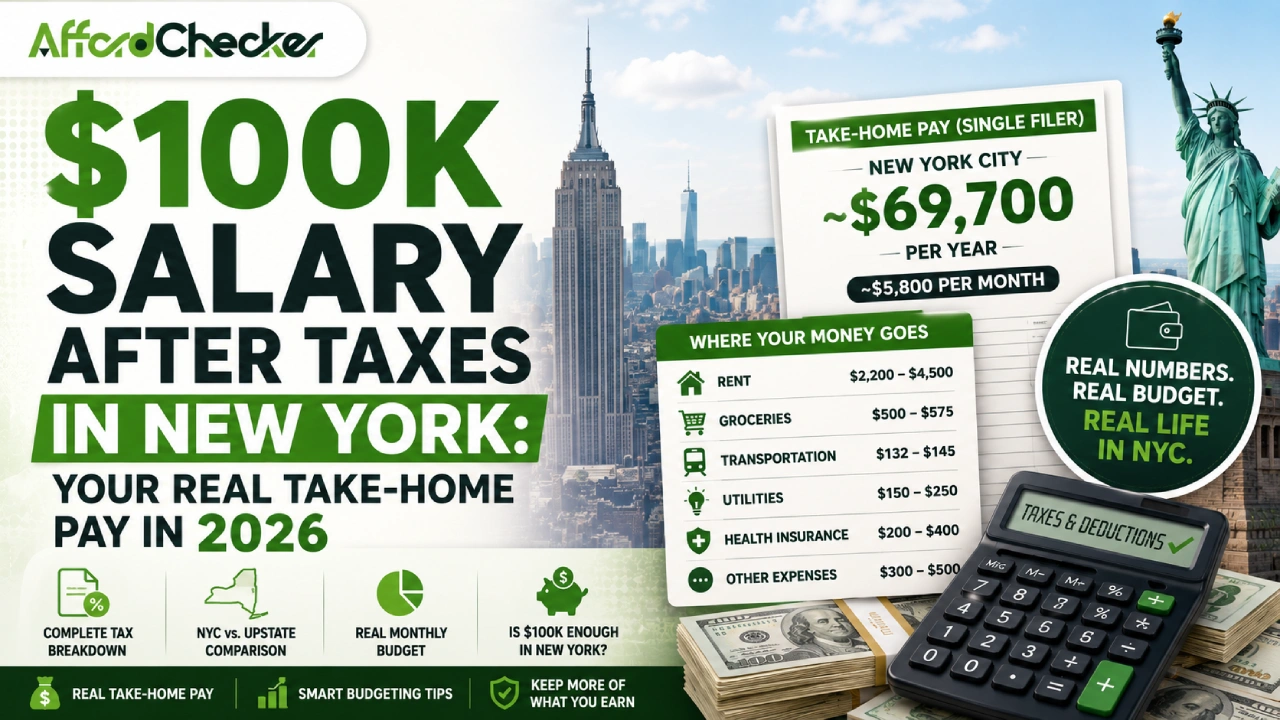
| New York City | Single | ~$68,000–$69,700 | ~$5,667–$5,808 |
| New York City | Married, Joint | ~$74,000–$76,000 | ~$6,167–$6,333 |
NYC residents pay a layer of city income tax that upstate New Yorkers don’t — which is why the same $100K salary leaves you with meaningfully less money depending on your zip code.
The Full Tax Breakdown for a $100K Salary in New York (2026)
For Single Filers — New York State (Not NYC)
| Tax Type | Amount |
|---|---|
| Federal Standard Deduction | $16,100 |
| Federal Taxable Income | $83,900 |
| Federal Income Tax | ~$13,176 |
| Social Security (6.2%) | $6,200 |
| Medicare (1.45%) | $1,450 |
| NY State Income Tax | ~$4,952 |
| Total Taxes Paid | ~$25,778 |
| Take-Home Pay | ~$74,222/year |
For Single Filers — New York City
If you live in any of the five boroughs, add NYC’s local income tax on top of everything above:
| NYC Tax Bracket | Rate |
|---|---|
| Up to $12,000 | 3.078% |
| $12,001–$25,000 | 3.762% |
| $25,001–$50,000 | 3.819% |
| Over $50,000 | 3.876% |
For a $100K salary, NYC city tax comes to roughly $3,751/year. That brings your total tax bill to about $29,529–$30,317, leaving you with approximately $69,683–$70,471 annually — or about $5,800/month.
Your effective tax rate as a single NYC resident on $100K is roughly 30.3%.
For Married Filers (Jointly) — New York State
| Tax Type | Amount |
|---|---|
| Federal Standard Deduction | $32,200 |
| Federal Taxable Income | $67,800 |
| Federal Income Tax | ~$7,662 |
| Social Security (6.2%) | $6,200 |
| Medicare (1.45%) | $1,450 |
| NY State Income Tax | ~$4,285 |
| Total Taxes Paid | ~$19,597 |
| Take-Home Pay | ~$80,403/year |
Married couples filing jointly get significantly wider tax brackets, which means a much lower effective rate. On a combined household income of $100K (or $100K from one earner), the tax savings versus a single filer are real — over $5,000 more per year in take-home pay.
Note: These figures represent a standard W-2 employee with no pre-tax deductions (no 401k, HSA, etc.). Your actual take-home may be higher once those are factored in. More on that below.
NYC vs. Upstate New York: The $5,500 Difference
Here’s a comparison that most salary articles completely skip.
The difference between living in New York City and living in, say, Buffalo or Albany on the same $100K salary is not trivial:
| Location | Annual Take-Home | Monthly Take-Home |
|---|---|---|
| NYC (single filer) | ~$69,700 | ~$5,808 |
| Upstate NY (single filer) | ~$74,200 | ~$6,183 |
That’s roughly $4,500 more per year just from not paying NYC’s city income tax. And upstate rent is dramatically cheaper — we’re talking $1,200–$1,800 for a nice one-bedroom vs. $3,200–$4,500 in Manhattan.
For some people, a $100K remote job based in NYC but lived in Albany or the Hudson Valley is genuinely life-changing from a financial standpoint.
Your Monthly Budget on $100K in New York City (2026)
Let’s say you’re single, living in NYC, and your take-home is $5,800/month. Here’s what a realistic budget looks like:
| Expense | Monthly Cost | Notes |
|---|---|---|
| Rent (1BR, outer borough) | $2,200–$2,800 | Brooklyn/Queens options |
| Rent (1BR, Manhattan) | $3,800–$4,500 | Significant budget strain |
| Groceries | $500–$575 | NYC is ~20% above national avg |
| Transportation (MetroCard) | $132–$145 | Unlimited monthly pass |
| Utilities | $150–$250 | Electric, internet |
| Health insurance | $200–$400 | Employer-based plan contribution |
| Dining out / entertainment | $300–$500 | Varies by lifestyle |
| Personal care / misc | $100–$200 | |
| Total (outer borough) | ~$3,682–$4,870 | |
| Total (Manhattan) | ~$5,282–$6,570 |
The uncomfortable truth: If you rent a one-bedroom in Manhattan, your entire take-home pay — all $5,800 of it — is almost entirely consumed by basic expenses before you save a single dollar. There’s almost nothing left for savings, debt repayment, or emergencies.
In the outer boroughs (Queens, parts of Brooklyn, the Bronx), you can make it work — but it takes real budgeting discipline. Living alone in Manhattan on $100K requires trade-offs that most financial advisors would raise an eyebrow at.
Is $100K a Good Salary in New York?
Compared to New York residents — yes, technically.
According to U.S. Census Bureau data, the median household income in New York State is approximately $85,820. Earning $100K puts you above that. And nationally, $100K places you comfortably in the top 30% of earners.
Compared to what NYC actually costs — it depends.
The cost of living in New York City is 131.5% higher than the national average, with housing being the primary driver. A SmartAsset study found that a single adult needs over $150,000 to truly live “comfortably” using the 50/30/20 budget framework in NYC.
On $100K after taxes (~$5,800/month), a 50/30/20 budget would look like:
- Needs (50%): $2,900
- Wants (30%): $1,740
- Savings (20%): $1,160
The problem? Average rent for a one-bedroom in NYC is around $4,500/month. That’s already 77% of your take-home pay for housing alone. The math simply doesn’t add up if you want to live alone in a desirable neighborhood and save money.
The verdict:
- $100K is a solid, livable salary in upstate New York or the outer boroughs with roommates.
- In Manhattan, solo, $100K is tight — livable, but with major trade-offs.
- Financially speaking, $100K in NYC has been compared to earning around $35,000 in terms of purchasing power in lower cost-of-living areas.
Borough-by-Borough Affordability on $100K
Not all of New York City is the same. Where you choose to live dramatically changes what $100K feels like:
Manhattan — Hardest. Studio apartments start around $2,800. One-bedrooms average $5,200. Without roommates, expect to spend 65–80% of take-home on rent alone.
Brooklyn — Variable. Trendy neighborhoods like Williamsburg and Park Slope run $3,000–$4,000 for a one-bedroom. More affordable areas like Bensonhurst or Flatbush start around $1,800–$2,200.
Queens — Most underrated. Astoria, Jackson Heights, and Flushing offer genuine value — one-bedrooms around $2,000–$2,600 — with solid transit connections to Midtown.
The Bronx — Most affordable. One-bedrooms in many Bronx neighborhoods start around $1,600–$2,000. Often overlooked, but a genuinely viable option for budget-conscious earners.
Staten Island — Car-dependent but affordable. One-bedrooms around $1,800–$2,400. The Staten Island Ferry is free, but commuting to most of Manhattan takes 45–75 minutes.
How to Legally Keep More of Your $100K
Here’s what a lot of articles skip: you don’t have to just accept that 30% tax bite. There are legal, IRS-approved ways to reduce your taxable income and increase your take-home.
1. Max Out Your 401(k)
The 2026 employee contribution limit is $23,500. Every dollar you contribute pre-tax reduces your federal, state, AND NYC taxable income simultaneously. If you contribute the full $23,500, your taxable income drops from $100,000 to $76,500 — moving you into lower brackets.
On a $100K salary in NYC, maxing your 401k could save you an estimated $5,000–$7,000 in total taxes annually while building your retirement.
2. Fund an HSA (If You Qualify)
If your employer offers a high-deductible health plan, you can contribute up to $4,300/year (individual) to a Health Savings Account in 2026. HSA contributions are triple tax-advantaged — pre-tax going in, tax-free growth, and tax-free for qualified medical expenses.
3. Use an FSA for Healthcare Costs
A Flexible Spending Account lets you set aside pre-tax dollars for medical costs. Up to $660 rolls over year to year. If you regularly spend on prescriptions, copays, or dental, this reduces your taxable income dollar-for-dollar.
4. Review Your W-4 Withholding
If you’re getting a large refund each April, you’ve essentially given the government an interest-free loan all year. Adjusting your W-4 to more accurate withholding means more money in each paycheck, not a lump sum return in spring.
What $100K Actually Looks Like With Smart Deductions
| Scenario | Taxable Income | Est. Annual Take-Home |
|---|---|---|
| No pre-tax deductions (NYC, single) | $100,000 | ~$69,700 |
| With 401(k) max ($23,500) | $76,500 | ~$76,000–$78,000 |
| With 401(k) + HSA ($4,300) | $72,200 | ~$77,000–$79,500 |
Strategic pre-tax contributions can shift your effective take-home up by several thousand dollars annually — without earning a single dollar more.
Real-World Salary Scenarios on $100K in New York
Scenario 1: Single, 28-Year-Old, Renting in Queens
- Monthly take-home: $5,800
- Rent (1BR, Astoria): $2,400
- Groceries: $500
- MetroCard: $140
- Utilities: $180
- Going out / dining: $400
- Savings: $700/month
- Verdict: Manageable. Saving $700/month isn’t luxurious, but you’re building a cushion. Life is decent.
Scenario 2: Single, 32-Year-Old, Renting Solo in Manhattan
- Monthly take-home: $5,800
- Rent (1BR, UWS): $4,200
- Groceries + dining: $900
- Transportation: $140
- Utilities: $200
- Left over: ~$360
- Verdict: Financially stressful. You’re one unexpected expense away from dipping into savings — or credit.
Scenario 3: Married Couple, Combined $100K, Living in Brooklyn
- Monthly take-home: ~$6,700 (married filing jointly)
- Rent (1BR, Flatbush): $2,200
- Groceries: $700
- Transportation (2 MetroCards): $280
- Utilities: $200
- Savings: $1,000+/month
- Verdict: Comfortable. This is the best setup — joint income, shared costs, outer borough pricing.
Pros and Cons of Earning $100K in New York
Pros
- Above state median income — you’re earning more than most New Yorkers
- Qualifies you for many apartments that require 40x monthly rent in annual income
- 401(k) matching from employers can boost total comp significantly
- NYC and NYS offer solid tax deductions if you’re strategic
- Strong career networking and advancement opportunities in NYC
Cons
- Effective take-home is 28–30% less than gross due to taxes
- NYC rent consumes an outsized portion of after-tax income
- Cost of living is 131.5% above the national average
- Living alone in Manhattan is financially strained
- High marginal tax rates limit the benefit of bonuses — a $10,000 bonus yields roughly $6,190 net
Smart Recommendation
If you’re earning $100K in New York:
- Live in the outer boroughs — Queens, the Bronx, and outer Brooklyn offer 30–40% lower rent than Manhattan with reasonable subway access.
- Contribute aggressively to your 401(k) — the tax savings in a state like New York are substantial. Even $10K/year in contributions meaningfully reduces your bill.
- Use the 28% rule for rent, not the typical 30% of gross — in New York, your net is far lower than your gross. Cap housing at 28–30% of your take-home, not your salary.
- If you’re remote — consider living upstate. You save NYC city tax and benefit from dramatically cheaper housing while maintaining the same salary.
- Build 3–6 months of emergency savings — NYC’s high cost of living makes financial volatility more dangerous. A $5,000 emergency that might be manageable in Texas can derail your budget in NYC.
Alternative Options If $100K Isn’t Stretching Far Enough
- Negotiate remote work flexibility to live in lower-cost NYC suburbs like Jersey City, Hoboken, or Astoria while keeping your NYC salary
- Look for employers with stronger benefits — health insurance, 401k match, commuter transit benefits, and HSA contributions can add $5,000–$15,000+ to your effective compensation
- Consider relocation if your field is portable — the same $100K in Texas or Florida goes dramatically further after state income taxes (Texas has none)
- Take on a roommate — even temporarily, splitting a two-bedroom saves $1,000–$1,500/month in NYC, which over two years is a down payment on a home elsewhere
Related reads:
Frequently Asked Questions
A single filer living in NYC takes home approximately $69,683 per year, or about $5,808 per month, after federal income tax, New York State income tax, NYC city income tax, and FICA taxes. This reflects an effective tax rate of roughly 30.3%.
If you live in New York State but not in New York City, your take-home on $100K is roughly $74,222 per year for a single filer, or about $6,183/month. You avoid the NYC local income tax, which saves you approximately $3,700–$4,500 annually.
It depends on your lifestyle. In the outer boroughs with a roommate or a two-bedroom split with a partner, $100K is manageable. Living alone in Manhattan on $100K is financially tight — rent typically consumes 65–80% of take-home pay. A SmartAsset analysis found that a single person needs $150,000+ to live truly comfortably in NYC using the 50/30/20 budgeting framework.
NYC residents pay a city income tax on top of federal and state taxes. On a $100K salary, this adds approximately $3,751/year to your tax bill. It’s one of the few U.S. cities that levies a local income tax, which is why $100K goes meaningfully further in other major cities.