The Short Answer
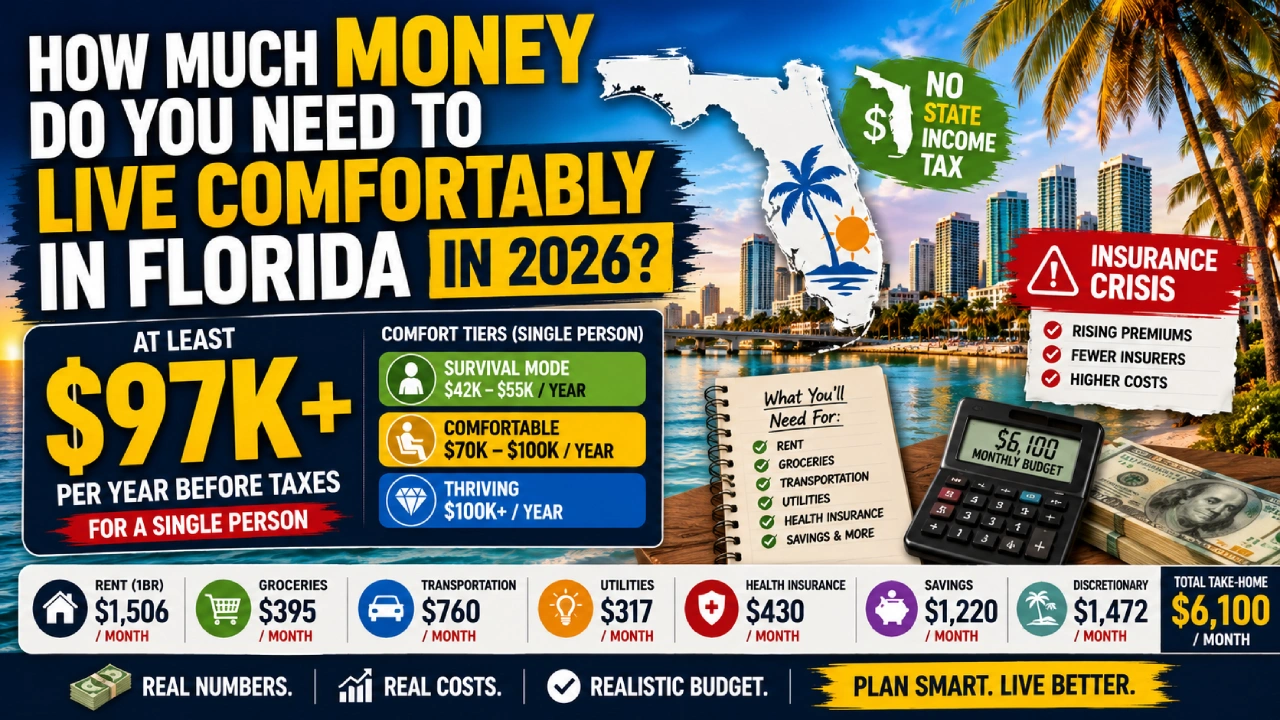
To live comfortably as a single person in Florida in 2026, you need to earn at least $97,386 per year before taxes, according to SmartAsset’s 2025 study. For a family of four, that number jumps to $217,651.
But here’s the thing — “comfortable” in Titusville looks nothing like “comfortable” in Miami. Your city, household size, and lifestyle choices will move that number up or down significantly.
Let’s break it all down so you know exactly what you’re working with.
Is Florida Actually Affordable in 2026?
Florida has a reputation for being a low-cost escape from high-tax states like New York and California. And in some ways, that reputation holds up — there’s no state income tax, property taxes are moderate, and the weather means lower heating costs year-round.
But the full picture is more complicated.
Florida ranked 39th out of 50 states in U.S. News & World Report’s Affordability Rankings. That puts it well below the midpoint. Housing costs have exploded over the past few years, homeowners insurance has become a full-blown crisis, and grocery prices consistently rank among the highest in the nation.
A study recently flagged that Florida ranks dead last for renters, with housing costs consuming roughly 37% of income — far above the 30% threshold most financial experts recommend.
The “affordable Florida” dream still exists in some pockets of the state. But in most metro areas, you’ll need a solid income to truly feel comfortable.
Three Comfort Tiers: Where Do You Fall?
Not everyone defines “comfortable” the same way. Here’s a practical way to think about it:
Tier 1 — Survival Mode ($42,000–$55,000/year) You’re covering the basics: rent, groceries, utilities, transportation, and basic health insurance. There’s very little room for savings, emergencies, or fun. This is the MIT Living Wage threshold for a single adult with no children in Florida ($50,117/year before taxes). It’s livable, but not comfortable.
Tier 2 — Comfortable ($70,000–$100,000/year) You can cover necessities, put some money in savings each month, enjoy occasional dining out, and handle surprise expenses without a panic attack. For a single person in most Florida cities outside Miami, this is where financial breathing room starts.
Tier 3 — Thriving ($100,000+/year) You’re building real wealth — contributing to a 401(k), taking vacations, and potentially working toward homeownership. In South Florida, Tampa, or Orlando, this is really where “comfortable” begins if you have a family.
What Does a Comfortable Budget Actually Look Like in Florida?
Using the 50/30/20 rule — 50% on needs, 30% on wants, 20% on savings and debt — here’s what a comfortable single person’s monthly budget looks like at $97,000/year (roughly $6,100/month take-home after federal taxes):
| Category | Monthly Amount |
|---|---|
| Rent (1BR apartment) | $1,506 |
| Groceries | $395 |
| Transportation (car + gas + insurance) | $760 |
| Utilities (electric, internet, water) | $317 |
| Health insurance + out-of-pocket | $430 |
| Savings + debt paydown | $1,220 |
| Discretionary (dining, entertainment, travel) | $1,472 |
| Total | $6,100 |
This math works in Jacksonville or Tallahassee. In Miami or Naples, rent alone can eat through $2,500–$3,000/month, which completely reshapes the budget.
Florida Living Costs by Category (2026 Data)
Housing
Housing is the biggest variable in your Florida budget. Statewide, the typical home value sits around $385,851, and median gross rent is $1,719/month.
Here’s how home values vary across major cities (Zillow, early 2026):
| City | Avg. Home Value |
|---|---|
| Homosassa Springs | $232,578 |
| Ocala | $270,353 |
| Tallahassee | $284,216 |
| Jacksonville | $288,709 |
| Lakeland | $313,493 |
| Orlando | $378,740 |
| Tampa | $374,105 |
| Miami | $585,611 |
| Naples | $574,392 |
The gap between Ocala and Miami is nearly $315,000. That’s not just a housing choice — it’s a lifestyle decision that will define your entire financial picture.
Groceries
Florida ranks 5th highest in the U.S. for food costs. The average single person spends about $395/month on groceries. A family of four can expect closer to $1,576/month.
Grocery costs are lowest in Tallahassee and highest in Monroe County (Key West) and Miami-Dade.
Utilities
Florida averages $422/month in total utilities. That breaks down roughly as:
- Electricity: $168/month (one of the highest in the nation — that AC runs year-round)
- Internet + cable: $113/month
- Natural gas: $105/month
- Water: $36/month
Transportation
Florida is a car-dependent state. Public transit is limited outside of a few urban cores, and most people commute by car daily. Transportation costs for a single adult average $9,103/year ($758/month), rising to over $16,938/year for a family with multiple children.
Factor in Florida’s higher-than-average auto insurance rates, which can swing dramatically by zip code. One Orlando resident noted that changing their zip code alone jumped their monthly auto insurance from $113 to $256 for two vehicles.
Health Insurance
The average annual per-capita health care cost in Florida is $8,996 — nearly $750/month. If your employer covers most of this, you’re in good shape. If you’re self-employed or buying on the marketplace, this becomes one of your biggest line items.
Child Care
This is the budget line that blindsides most families. Florida child care costs average:
- Infant classroom: $1,364/month per child
- Toddler classroom: $790/month per child
- Home-based family care: $989/month per child
A family of four in Orlando with one infant in daycare is easily spending $1,364/month just for one child’s care — before food, rent, or anything else. Multiple Reddit users in the r/florida community noted that daycare alone was $16,000+ per year and felt completely unsustainable.
Homeowners & Renters Insurance
This deserves its own spotlight in 2026. Florida’s insurance market is in genuine crisis. Many major insurers have pulled out of the state entirely. Homeowners insurance is among the most expensive in the country due to hurricane and flood risks. Federal flood insurance costs have also been rising sharply.
This is a cost that many people moving from out of state completely underestimate. Budget at least $3,000–$6,000/year for homeowners insurance in most parts of Florida, and more in coastal areas.
How Much Do You Need by City?
Florida is not one housing market — it’s dozens. Here’s a practical income guide by major metro area:
| City / Area | Single, No Kids | Couple, No Kids | Family of 4 |
|---|---|---|---|
| Jacksonville | $70,000 | $95,000 | $140,000 |
| Tallahassee | $68,000 | $90,000 | $135,000 |
| Ocala / Gainesville | $65,000 | $88,000 | $130,000 |
| Orlando | $85,000 | $110,000 | $160,000 |
| Tampa / St. Pete | $90,000 | $120,000 | $175,000 |
| Fort Lauderdale | $100,000 | $140,000 | $195,000 |
| Miami / Miami-Dade | $115,000+ | $160,000+ | $220,000+ |
| Naples / Collier County | $110,000+ | $155,000+ | $210,000+ |
These are estimates for “Tier 2” comfort — needs covered, modest savings, some discretionary spending. If you want to build wealth or save aggressively for a home, add 20–30%.
Florida’s Hidden Affordability Problem: Insurance + Inflation
Here’s something the polished competitor articles often gloss over: Florida’s affordability problem in 2026 isn’t just about rent. It’s a compounding squeeze of multiple rising costs hitting simultaneously.
Homeowners insurance in Florida has roughly doubled in some counties over the past five years. Grocery prices remain persistently elevated. Auto insurance is higher than the national average. And the state’s minimum wage of $14/hour still falls far short of what MIT’s Living Wage Calculator identifies as necessary ($24.09/hour for a single adult with no children).
Meanwhile, Florida’s population growth boom is beginning to slow. A 2025 Wall Street Journal report noted that Florida’s population growth has fizzled as high costs drive away the middle class. The Sunshine State is pricing out the exact demographic that made it attractive in the first place.
Living Wage vs. Comfortable Wage: The Real Numbers
The MIT Living Wage Calculator (updated February 2026) puts Florida’s required annual income at:
| Household Type | Living Wage (Before Taxes) |
|---|---|
| Single adult, no children | $50,117 |
| Single adult, 1 child | $82,929 |
| Single adult, 2 children | $103,746 |
| 2 adults (both working), no children | $66,917 |
| 2 adults (both working), 1 child | $94,060 |
| 2 adults (both working), 2 children | $111,714 |
Remember: these are living wages — covering basic needs with nothing left for real savings, retirement, or discretionary spending. For genuine comfort, apply the 50/30/20 rule on top of these figures.
Practical rule of thumb: Take your MIT living wage threshold and multiply by 1.5 to find your comfort income target.
Can You Live in Florida on $50,000, $70,000, or $100,000?
On $50,000/year: Doable, but tight. You’re essentially at the survival threshold for a single adult. Roommates help significantly. You’ll need to choose one of Florida’s more affordable cities — Ocala, Gainesville, or Tallahassee are your best options. No new cars, very limited savings, and emergencies will stress your budget.
On $70,000/year: Much more manageable for a single person in a mid-tier city like Jacksonville or Orlando. You can rent a decent one-bedroom, drive a reasonable car, save modestly, and have some money left for weekends. A couple at $70,000 combined will feel stretched in most Florida metros.
On $100,000/year: For a single person, this is genuinely comfortable in most of Florida outside South Florida. For a couple, it’s a solid foundation — especially if you bought a home before 2021 or live outside the major metros. For a family of four, $100K starts to feel tight once child care and insurance enter the picture.
On $150,000+ (household): This is where family life in Florida starts to feel stable. You can own a home, fund retirement, cover child care, and take a vacation or two. In Miami or Palm Beach, you’ll still feel the squeeze, but most families are genuinely comfortable at this level.
Cheapest Cities to Live in Florida in 2026
If affordability is your priority, these Florida cities offer the best value:
Titusville — Known as the lowest overall cost of living in the state. Located near the Space Coast, with easy access to beaches and Kennedy Space Center. Home values well below the state median.
Jacksonville — Florida’s largest city by area, with a cost-of-living index of 92.9 (below the national average). Strong job market, 22 beaches, and no shortage of things to do.
Tallahassee — The state capital comes in with a cost-of-living index of 93.0. College town energy, lower rents, and the lowest average grocery costs in the state.
Ocala — Sometimes called “Horse Country,” Ocala is inland and considerably cheaper than coastal cities. Great for families looking to stretch a mid-range income.
Gainesville — Home of the University of Florida. Affordable, vibrant, and well-connected despite being smaller than Florida’s major metros.
Pros and Cons of Living in Florida
Pros
- No state income tax — keeps more of every paycheck
- 237 sunny days per year, zero snow
- Diverse job market in healthcare, tech, tourism, and finance
- Strong retiree infrastructure and benefits
- Lots of free and low-cost outdoor recreation (90% of beaches are public)
- Lower cost than California, New York, or Massachusetts
Cons
- Housing costs have surged — especially rentals
- Homeowners insurance is in full crisis mode
- Property insurance for flood coverage is rising steeply
- High electricity bills (AC runs 9+ months a year)
- Car-dependent — public transit is minimal outside of Miami
- Hurricane risk is real and costs money to prepare for
- Florida ranks last nationally for renters’ cost burden
Smart Budgeting Recommendations for Florida Residents
1. Keep housing under 30% of gross income. With median rents above $1,700 statewide, you’ll need to earn at least $68,000/year to hit that target in an average apartment.
2. Shop homeowners insurance aggressively. Get quotes from Citizens Insurance (Florida’s state-backed insurer of last resort) and any private insurers still operating in your area. This cost varies wildly.
3. Build a hurricane preparedness fund. Budget $500–$1,000/year for storm supplies, generator maintenance, and potential evacuation costs. This isn’t optional.
4. Factor in auto insurance by zip code before you commit to a neighborhood. As noted above, a zip code change can double your premium.
5. If you have kids, child care costs should be job #1 before choosing a city. The difference in child care costs between counties can run $400–$600/month per child.
6. Use the 50/30/20 rule as your north star. Needs at 50%, wants at 30%, savings and debt at 20%. If your rent alone is pushing past 30% of take-home, your entire budget math breaks down.
Alternative Options: States to Consider
If Florida’s rising costs are giving you pause, here are comparable warm-weather states worth comparing:
- Texas — No income tax, generally lower insurance costs in inland cities, but summers are brutal and property taxes are higher
- Tennessee — No income tax, lower cost of living, growing job market in Nashville and Memphis
- Georgia — Moderate cost of living, strong Atlanta job market, more manageable insurance costs
- North Carolina — Strong research triangle economy, lower housing costs, four seasons if you want them
Each has its own trade-offs, but if Florida’s insurance premiums and housing costs are the dealbreaker, these states offer similar tax benefits at lower total cost.
FAQs
According to a 2025 SmartAsset study, a single person needs to earn at least $97,386/year to live comfortably using the 50/30/20 budget rule. In more affordable cities like Jacksonville or Tallahassee, you may be comfortable closer to $70,000–$80,000.
Florida’s minimum wage is $14.00/hour as of January 2026. That works out to roughly $29,120/year — significantly below the living wage of $50,117 calculated by MIT for a single adult with no children.
More than it used to be. Florida ranks 39th out of 50 states in affordability per U.S. News & World Report. Housing costs, homeowners insurance, and grocery prices are all above the national median.
In most Florida cities, a family of four at $100,000/year will feel financially stretched. You’ll cover necessities but savings and discretionary spending will be limited — especially if you’re renting and paying for child care. A household income of $140,000–$175,000 is more realistic for genuine comfort.
Titusville has the lowest overall cost of living in Florida, followed by Ocala, Gainesville, Tallahassee, and Jacksonville.
No. Florida has no state income tax, which effectively increases your take-home pay compared to most other states.
Median gross rent statewide is $1,719/month. Studio apartments average $1,480/month, while three-bedroom units run approximately $1,933/month. Miami and Palm Beach are significantly higher.
For a single adult in an affordable Florida city, yes — $70,000 is a reasonable comfort salary. In Orlando or Tampa, it’s workable with careful budgeting. In Miami or Fort Lauderdale, $70,000 will feel tight.
Final Verdict
Florida is still one of the most livable states in America — but the math has changed. The “move to Florida and save money” calculus that worked a decade ago is no longer automatic.
For a single person, you need $85,000–$100,000/year to genuinely live comfortably in most Florida cities. For a family of four, budget $150,000–$220,000+ depending on your city and whether you’re renting or own a home.
The no-income-tax advantage is real. But it gets eaten up fast by high insurance costs, above-average groceries, and a car-dependent lifestyle.
If you choose your city wisely, keep housing costs in check, and budget proactively for Florida-specific expenses like hurricane prep and homeowners insurance, the Sunshine State can absolutely deliver a high quality of life. You just need to go in with clear eyes — and realistic numbers.