The Honest Truth About “Cheap” States in 2026
Everyone’s talking about affordability right now — and for good reason. Rent is still brutal in most major cities, mortgage rates are hovering around 6.5%, and the cost of everyday life keeps creeping up. If you’re looking for somewhere your money actually stretches, you’re not alone.
But here’s what most “cheapest states” lists get wrong: they show you a number without telling you what your life would actually look like. A low cost-of-living index means nothing if your salary tanks the moment you move, or if your monthly grocery bill eats up what you saved on rent.
This guide fixes that. We’re breaking down the cheapest states to live in the USA in 2026 with real monthly budgets, salary examples, and honest trade-offs — so you can actually decide if moving makes sense for your situation.
Quick Answer: The 10 Cheapest States to Live in the USA in 2026
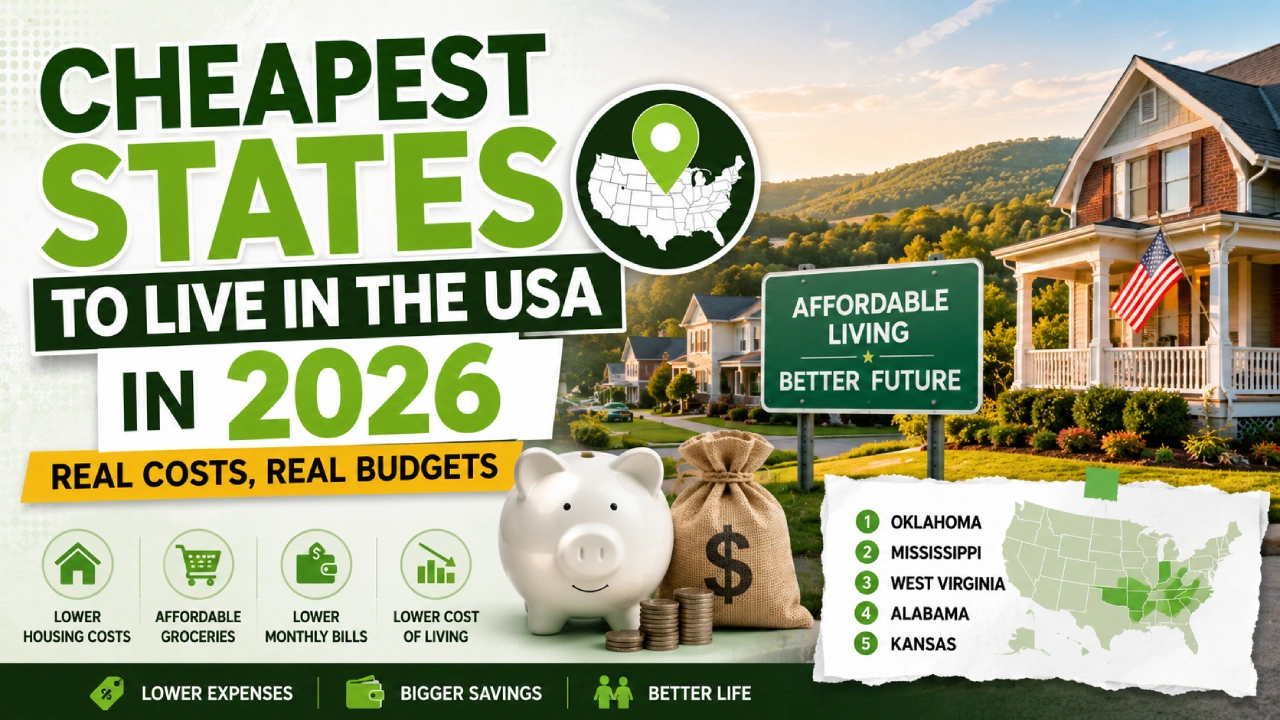
Based on a composite index of housing, utilities, groceries, transportation, and taxes, here are the most affordable states right now:
| Rank | State | Cost of Living Index | Avg Rent (2BR) | Median Home Price |
|---|---|---|---|---|
| 1 | Oklahoma | 86.0 | ~$1,035/mo | ~$246,000 |
| 2 | Mississippi | 87.3 | ~$1,305/mo | ~$177,000 |
| 3 | West Virginia | 88.3 | ~$900/mo | ~$148,000 |
| 4 | Alabama | 88.6 | ~$807/mo | ~$220,000 |
| 5 | Kansas | 88.8 | ~$1,243/mo | ~$215,000 |
| 6 | Arkansas | 89.6 | ~$1,093/mo | ~$189,000 |
| 7 | Missouri | 89.0 | ~$1,273/mo | ~$230,000 |
| 8 | Iowa | 89.7 | ~$1,220/mo | ~$203,000 |
| 9 | Michigan | 90.1 | ~$1,100/mo | ~$230,000 |
| 10 | Tennessee | 90.3 | ~$1,100/mo | ~$240,000 |
Index score = 100 is the U.S. national average. Lower is cheaper.
A state with an index of 86 means everyday life costs about 14% less than the national average — across housing, food, utilities, and more.
What Does It Cost to Actually Live in These States?
Here’s what most articles skip: a full monthly budget. Let’s run the real numbers for a single person and a family of three in the top affordable states.
Monthly Budget: Single Person in Oklahoma
Oklahoma ranks as the most affordable state overall in 2026, with a cost-of-living index of just 86.
| Expense | Monthly Cost |
|---|---|
| 1BR Apartment Rent | $820 |
| Utilities (electric, gas, water) | $130 |
| Groceries | $280 |
| Transportation (car + gas) | $300 |
| Health Insurance (ACA plan) | $250 |
| Phone | $60 |
| Misc / Entertainment | $150 |
| Total | ~$1,990/mo |
To live comfortably on this budget, you’d need a take-home income of about $2,400–$2,600/month — or roughly $35,000–$38,000/year before taxes. That’s well within reach for most working adults in Oklahoma, where the median household income sits around $65,000.
Monthly Budget: Family of Three in Mississippi
| Expense | Monthly Cost |
|---|---|
| 2BR Apartment Rent | $1,100 |
| Utilities | $175 |
| Groceries (family) | $650 |
| Transportation (one car) | $380 |
| Health Insurance | $550 |
| Childcare (1 child, part-time) | $600 |
| Phone (2 lines) | $100 |
| Misc | $200 |
| Total | ~$3,755/mo |
A family of three needs roughly $55,000–$60,000/year to live comfortably in Mississippi — significantly less than the $80,000+ needed for the same lifestyle in Florida, Texas cities, or any coastal market.
State-by-State Breakdown: The Top 10 Cheapest States in 2026
1. Oklahoma — Most Affordable Overall
Cost of Living Index: 86.0 | Median Home Price: ~$246,000 | Avg Rent (2BR): ~$1,035/mo
Oklahoma consistently lands at the top of affordability rankings, and the 2026 data confirms it. Oklahoma City and Tulsa are genuinely underrated mid-sized cities — growing tech and energy sectors, solid healthcare employers, and housing costs that are nearly 25% below the national average.
The catch? Car insurance in Oklahoma runs higher than many states due to weather risk, and the state sits squarely in Tornado Alley. Homeowners insurance can cost $2,500–$3,500/year depending on your location. Budget for that.
Best for: Families, remote workers, first-time homebuyers
Salary needed to live comfortably: ~$45,000–$55,000/year
Biggest hidden cost: Homeowners insurance and car insurance
2. Mississippi — Lowest Housing Costs in America
Cost of Living Index: 87.3 | Median Home Price: ~$177,000 | Avg Rent (2BR): ~$1,305/mo
Mississippi has the lowest median monthly mortgage payment in the entire country — roughly $790/month on a median-priced home. That’s less than a studio apartment in most coastal cities.
The Gulf Coast (Biloxi, Gulfport) gives you actual beach access at small-town prices. Jackson, the capital, has solid healthcare and government jobs. Oxford and Starkville are charming college towns with surprising amenities.
The honest downside: Mississippi has the lowest median household income of any state at around $54,900. Job opportunities outside healthcare, education, and government can be limited. If you work remotely or are retiring, Mississippi is a financial game-changer. If you’re job-hunting in private industry, research carefully.
Best for: Retirees, remote workers, coast lovers on a budget
Salary needed to live comfortably: ~$40,000–$50,000/year
Biggest hidden cost: Hurricane-zone homeowners insurance ($2,500–$3,500/year)
3. West Virginia — Cheapest Home Prices in the Nation
Cost of Living Index: 88.3 | Median Home Price: ~$148,000 | Avg Rent: ~$900/mo
No state beats West Virginia on raw home prices. A median home here costs less than a down payment in San Francisco. The state is 15–16% below the national average on overall cost of living, and property taxes are among the lowest anywhere — roughly $835/year on a median home.
Morgantown (West Virginia University) and Charleston offer real amenities. The Appalachian Mountains provide stunning scenery and outdoor recreation year-round.
The trade-off is real: West Virginia has faced population decline and limited private-sector job growth. If you need a local employer, your options will be more limited than in Ohio or Indiana. For remote workers, retirees, or nature lovers, it’s one of the best-kept secrets in American affordability.
Best for: Remote workers, retirees, outdoor enthusiasts
Salary needed to live comfortably: ~$38,000–$48,000/year
Biggest hidden cost: Potential need for a car (limited public transit)
4. Alabama — Rock-Bottom Property Taxes
Cost of Living Index: 88.6 | Median Home Price: ~$220,000 | Avg Rent (2BR): ~$807/mo
Alabama’s superpower is its property tax rate — just 0.38–0.40%, one of the lowest in the country. On a $220,000 home, you’re paying about $60–$65/month in property taxes. Compare that to New Jersey ($500+/month) or Illinois ($400+/month) and the savings are staggering over 30 years.
Huntsville is Alabama’s fastest-growing city and a genuine tech and aerospace hub — NASA, Boeing, and Lockheed Martin all have major operations there. Birmingham has a solid healthcare and banking economy. The Gulf Coast in Mobile offers coastal living without Florida prices.
Best for: Families with kids, property buyers, defense/aerospace workers
Salary needed to live comfortably: ~$45,000–$55,000/year
Biggest hidden cost: Homeowners insurance (tornado and hurricane risk in southern counties)
5. Kansas — Midwestern Affordability With Urban Options
Cost of Living Index: 88.8 | Median Home Price: ~$215,000 | Avg Rent (2BR): ~$1,243/mo
Kansas gets overlooked, but Kansas City (straddling Kansas and Missouri) is one of the most underrated large metros in the country. Overland Park on the Kansas side consistently ranks among the best suburbs in America for families. Wichita has a solid aviation industry. Lawrence is a vibrant college town.
Property taxes are above average for an affordable state (around 1.3%), which adds $200–$230/month to your housing costs. That’s something to budget for. Still, the overall package — home prices, groceries, utilities — keeps Kansas firmly in the top five.
Best for: Families, corporate relocations, young professionals
Salary needed to live comfortably: ~$48,000–$58,000/year
Biggest hidden cost: Higher-than-average property taxes for the region
6. Arkansas — Prices Actually Dropped in 2025
Cost of Living Index: 89.6 | Median Home Price: ~$189,000 | Avg Rent (2BR): ~$1,093/mo
Here’s something you won’t find on many lists: Arkansas is one of the few states where home prices actually declined slightly in 2025. That means buyers entering in 2026 may be catching a genuine dip. Median home prices of $189,000 — that’s roughly what a parking space costs in Manhattan.
Northwest Arkansas (Bentonville, Fayetteville, Rogers) has been completely transformed by Walmart’s corporate headquarters and the surrounding tech and corporate ecosystem. It’s now one of the fastest-growing metros in the country — with small-town character and big-city salaries.
Watch the homeowners insurance here: tornado and severe weather risk pushes premiums to $3,500–$4,000/year in some areas.
Best for: Young professionals, corporate relocations, homebuyers looking for value
Salary needed to live comfortably: ~$42,000–$52,000/year
Biggest hidden cost: Homeowners insurance (one of the higher in our top 10)
7. Missouri — Two Major Cities, One Affordable State
Cost of Living Index: 89.0 | Median Home Price: ~$230,000 | Avg Rent (2BR): ~$1,273/mo
Missouri’s hidden advantage: two completely distinct major metros. Kansas City in the west is a booming logistics, healthcare, and financial services hub with a world-class barbecue scene. St. Louis in the east offers some of the most affordable urban housing of any major American city — you can buy a solid single-family home in great neighborhoods for $200,000–$300,000.
The median household income is around $69,000, giving Missouri one of the better income-to-housing-cost ratios on this list. Tornado risk is real, which nudges homeowners insurance to $3,000–$3,500/year.
Best for: Professionals, families seeking urban amenities on a budget
Salary needed to live comfortably: ~$48,000–$58,000/year
Biggest hidden cost: Homeowners insurance, vehicle theft rates in some urban areas
8. Iowa — Des Moines Is More Than a Punchline
Cost of Living Index: 89.7 | Median Home Price: ~$203,000 | Avg Rent (2BR): ~$1,220/mo
Des Moines might be the most underrated mid-sized city in America. A booming insurance and financial sector, low crime for its size, fast-growing suburbs, and home prices that would make coastal residents weep with jealousy. The broader Iowa job market is solid in agriculture, manufacturing, and healthcare.
The catch: Iowa has above-average property taxes (around 1.4–1.5%), so your actual monthly housing payment will be higher than the sticker price suggests. Budget an extra $250–$300/month for taxes if you’re buying.
Best for: Finance workers, families, anyone tired of paying coastal rent
Salary needed to live comfortably: ~$48,000–$58,000/year
Biggest hidden cost: Property taxes (among the highest in the affordable states category)
9. Michigan — Great Lakes, Great Value
Cost of Living Index: 90.1 | Median Home Price: ~$230,000 | Median Household Income: ~$71,000
Michigan has the highest median household income in our top 10 — about $71,000 — which means residents get the most financial breathing room of any state on this list. Detroit has seen genuine revitalization, and outside the metro, Traverse City, Ann Arbor, and Grand Rapids are genuinely beautiful places to live.
The downside: property taxes run about 1.28%, adding $230–$250/month to a median-priced home. Winters are real. But homeowners insurance is reasonable ($2,400/year), and the Great Lakes shoreline is honestly one of the best lifestyle perks of any affordable state.
Best for: Automotive/manufacturing workers, outdoor lovers, remote workers who want four seasons
Salary needed to live comfortably: ~$50,000–$60,000/year
Biggest hidden cost: Property taxes and winter heating bills
10. Tennessee — The Southern Sweet Spot
Cost of Living Index: 90.3 | Median Home Price: ~$240,000 | No State Income Tax
Tennessee has one major financial advantage that doesn’t show up in the cost-of-living index: zero state income tax. If you’re earning $75,000/year, that saves you $3,000–$5,000 annually compared to living in a high-tax state. Nashville is booming (though it’s pushing affordability limits), but Memphis, Knoxville, and Chattanooga offer genuine affordability with solid job markets.
Best for: High earners who want to keep more of their income, retirees
Salary needed to live comfortably: ~$48,000–$58,000/year
Biggest hidden cost: Nashville’s rapid appreciation is bleeding into surrounding counties
Cheapest vs. Most Expensive States: The Real Gap
To understand how much you’d actually save, here’s the monthly cost difference for a single person:
| State | Monthly Cost of Living (est.) | Annual Savings vs. California |
|---|---|---|
| Oklahoma | ~$2,000 | ~$28,800/year |
| Mississippi | ~$2,100 | ~$27,600/year |
| West Virginia | ~$1,900 | ~$30,000/year |
| National Average | ~$3,200 | — |
| Florida | ~$3,400 | -$2,400/year |
| New York | ~$4,500 | -$15,600/year |
| California | ~$4,400 | -$14,400/year |
| Hawaii | ~$5,200 | -$22,800/year |
Estimates based on single-person household, including rent, utilities, groceries, transportation.
Who Should Move to a Cheap State in 2026?
Not everyone benefits from the same state. Here’s a quick breakdown:
Remote Workers: Oklahoma, West Virginia, Missouri. You keep your coastal salary, slash your cost of living, and potentially buy a home outright within a few years.
Retirees on Fixed Income: Mississippi, Alabama, West Virginia. Low property taxes, low healthcare costs, and a slower pace of life stretch retirement dollars further than anywhere in the country.
Young Families: Kansas (Overland Park), Indiana, Missouri, Tennessee. Strong school districts, low property taxes, and space to grow without drowning in a mortgage.
First-Time Homebuyers: West Virginia, Mississippi, Arkansas. Entry-level home prices under $200,000 make homeownership accessible even at today’s interest rates.
Job Seekers: Alabama (Huntsville), Missouri, Michigan. Strong job markets in aerospace, healthcare, manufacturing, and tech without the coast’s cost of entry.
The Hidden Costs Nobody Warns You About
Moving to an affordable state can save you thousands — but only if you plan for the less obvious costs.
Homeowners Insurance: Gulf Coast and tornado-belt states (Mississippi, Louisiana, Arkansas, Oklahoma, Alabama) carry insurance costs of $3,000–$4,000/year. In a coastal California city, you might pay $1,200. This can erase $150–$200/month of your “savings.”
Property Taxes Vary Wildly: Iowa and Michigan have low purchase prices but above-average property taxes (1.3–1.4%). Alabama and West Virginia are dirt cheap on both. Always calculate total monthly housing cost — not just the mortgage payment.
Healthcare Access: Rural counties in cheap states often lack specialists, top-tier hospitals, or urgent care facilities. If you have complex health needs, verify what’s within reasonable distance before committing.
Job Market Reality: The reason homes cost less in Mississippi is partly because wages are lower and private-sector jobs are fewer. If you rely on local employment (not remote), research your specific industry before assuming you can replicate your current income.
Internet in Rural Areas: Remote workers take note — broadband access is still inconsistent in rural parts of West Virginia, Mississippi, and parts of Arkansas. Confirm actual speeds, not just “available” coverage.
Pros & Cons: Moving to a Cheap State in 2026
Pros
- Housing costs 10–40% below the national average
- Lower property taxes (in most affordable states)
- More space — larger homes for less money
- No state income tax in Tennessee, South Dakota
- Slower pace of life, stronger community ties
- Real potential to pay off a home, build wealth faster
Cons
- Job markets often smaller and less diverse
- Natural disaster risk (tornadoes, hurricanes) in many top affordable states
- Fewer cultural amenities, international dining, arts scenes
- Healthcare access can be limited in rural areas
- Lower wages can offset lower costs if you’re working locally
- Some states face population decline (West Virginia), limiting home appreciation potential
Smart Recommendation: The Best Affordable States by Goal
Top value pick for 2026: Oklahoma and Missouri — affordable housing, solid job markets, no extreme weather trade-offs that other cheap states carry.
Ideal choice for remote workers: West Virginia or Mississippi — live on a big-city salary, pay small-town prices, build wealth fast.
Great option for retirees: Alabama — lowest property taxes in the country, warm climate, growing healthcare infrastructure in cities like Huntsville and Birmingham.
Smart pick for budget-conscious homebuyers: West Virginia or Arkansas — entry prices under $200,000, realistic path to homeownership even at 6.5% rates.
Family-friendly states to consider: Tennessee or Kansas — no state income tax (TN), top suburban rankings (KS), strong school options in specific metro areas.
Alternative Options: Other Affordable States Worth Considering
If the top 10 don’t fit your situation, consider these:
Indiana (Index: 91.0): Indianapolis is one of the fastest-growing metros in the Midwest — life sciences, tech, and sports industry jobs. Reasonable property taxes, solid schools in suburban areas.
Georgia (Index: 92.5): Atlanta’s job market is elite-tier. While the city itself is pricier, suburbs like Alpharetta, Marietta, and Cartersville offer dramatically lower costs while staying in commuting distance.
Nebraska (Index: 92.6): Omaha is wildly affordable for what it offers — strong financial sector, low crime, great food scene. Home prices well under $300,000.
South Dakota (Index: 91.9): No state income tax, low cost of living, and a surprisingly strong small-business environment. Sioux Falls specifically has boomed in recent years.
Frequently Asked Questions
Oklahoma has the lowest cost-of-living index in 2026 at 86.0 — about 14% below the national average. When you factor in housing, groceries, utilities, and taxes, residents in Oklahoma City or Tulsa spend meaningfully less on everyday life than Americans living in most other states. Mississippi and West Virginia follow closely, with the absolute lowest home prices and mortgage payments in the country.
Yes — in most of the top 10 affordable states, $50,000/year is enough to live comfortably as a single person or as part of a dual-income household. In Oklahoma or Mississippi, a $50,000 salary covers rent, groceries, transportation, health insurance, and leaves meaningful room for savings. A family of three would want $60,000–$70,000 to feel truly comfortable once childcare and healthcare are factored in.
West Virginia has the lowest median home prices in the country at around $148,000. Mississippi ($177,000) and Arkansas ($189,000) follow closely. These states offer the lowest monthly mortgage payments — in Mississippi, a median-priced home financed with 20% down at 6.5% costs roughly $790/month in principal and interest. That’s less than renting a one-bedroom apartment in most U.S. cities.
Homeowners insurance is the most commonly overlooked expense. States like Oklahoma, Mississippi, Arkansas, and Louisiana sit in high-risk zones for tornadoes and hurricanes, pushing annual insurance premiums to $3,000–$4,000 — sometimes higher for coastal properties. Property taxes are the second biggest variable: Iowa and Michigan have much higher rates than Alabama or West Virginia, which can add $200–$250/month to your housing costs even on an affordable home.
Final Verdict
The cheapest states to live in the USA in 2026 are concentrated in the South and Midwest — and the savings are real. Oklahoma, Mississippi, West Virginia, Alabama, and Kansas consistently offer 10–20% lower overall costs than the national average, with home prices that are simply unimaginable in coastal markets.
But “cheap” isn’t enough on its own. The best move for you depends on your income situation, your industry, your tolerance for weather risk, and what you want your daily life to look like. A $150,000 home in rural Mississippi is a great deal if you work remotely — and a harder pill to swallow if you need a local job market that doesn’t yet exist there.
Do the math on your full monthly budget, not just rent. Factor in insurance, property taxes, and healthcare access. Visit before you commit. And if the numbers work — and for a lot of Americans in 2026, they really do — the cheapest states offer a genuinely different path to financial stability and homeownership.