
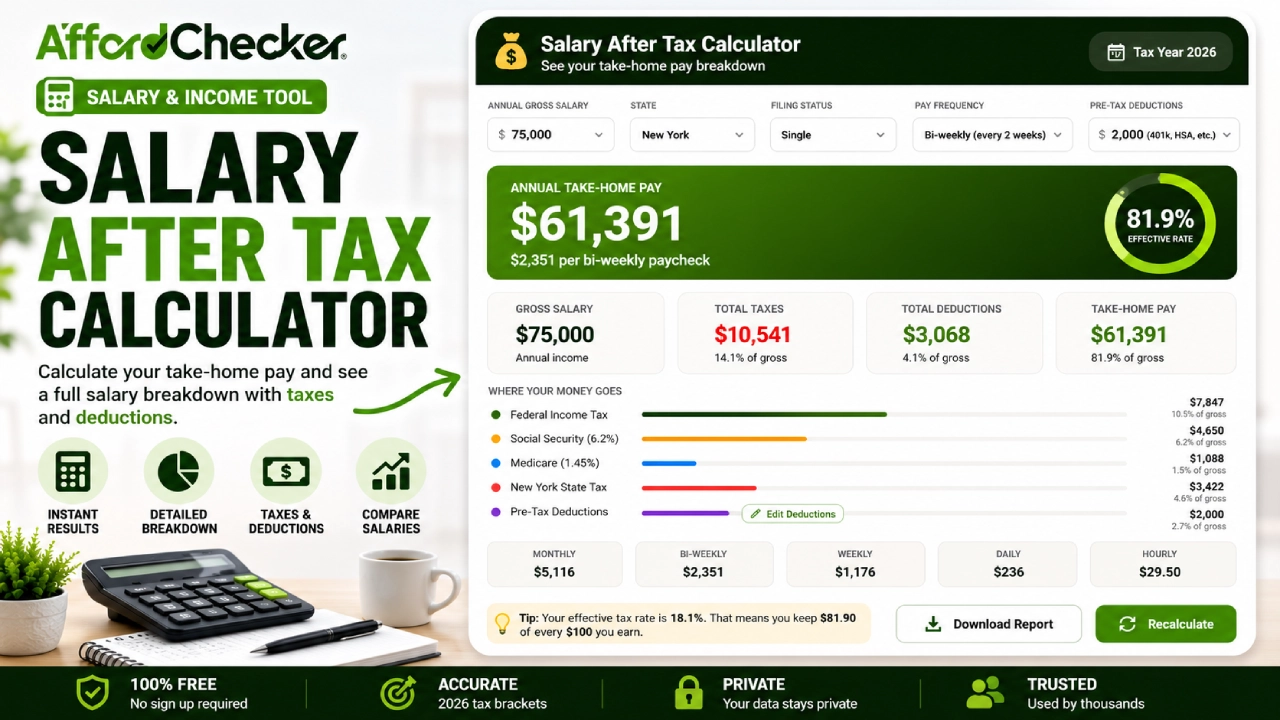
Salary After Tax Calculator USA — Find Your Real Take-Home Pay (2026)
Most people know their salary. Far fewer know what they actually take home once the government is done with it. If you’ve ever looked at your paycheck and wondered where your money went, you’re not alone — and you’re in the right place.
This page walks you through exactly how US taxes reduce your gross salary, what to expect in 2026 based on the latest IRS figures, and how where you live can shift your take-home pay by thousands of dollars a year. Use the calculator above to get your personalized result, then read on to understand every line of your paycheck.
What Is Salary After Tax?
Salary after tax — also called take-home pay, net pay, or after-tax income — is what’s left of your paycheck once federal income tax, state income tax, and payroll taxes have been withheld.
In the US, your employer reports your gross salary (the number on your offer letter), but that’s not the number that hits your bank account. Between federal and state obligations, most American workers take home somewhere between 65% and 80% of what they earn, depending on income level and where they live.
The gap between gross and net can be surprising. A $75,000 salary in California, after federal and state taxes plus FICA, might yield roughly $52,000 in actual take-home pay — about 30% less. In Florida, that same salary produces closer to $57,000 in net pay because there’s no state income tax. Understanding this difference matters whether you’re negotiating a new job offer, planning a budget, or deciding which state to live in.
What Taxes Come Out of Your US Paycheck?
Three main categories of tax reduce your gross pay every pay period: federal income tax, state income tax, and FICA payroll taxes. Here’s how each one works.
Federal Income Tax
The US federal income tax system is progressive, meaning your income is taxed in layers — not all at one flat rate. Each bracket represents a range of taxable income taxed at a specific rate. Only the income that falls within a given bracket is taxed at that bracket’s rate. The rest is taxed at lower rates.
For 2026, the federal income tax still uses seven rates: 10%, 12%, 22%, 24%, 32%, 35%, and 37%. These rates were made permanent by the One Big Beautiful Bill Act (OBBBA), signed into law in July 2025, which locked in the lower rates introduced by the 2017 Tax Cuts and Jobs Act rather than allowing them to expire.
Your taxable income — the figure the federal brackets actually apply to — is your gross income minus your standard deduction (or itemized deductions, whichever is larger) and any other above-the-line deductions like 401(k) contributions.
State Income Tax
On top of federal taxes, most states collect their own income tax. Rates vary dramatically — from 0% in seven states to over 13% at the top end in California. This is one of the biggest variables in take-home pay calculations and the main reason why two workers earning identical salaries can have very different financial realities depending on where they live.
Some states use flat rates, where every earner pays the same percentage. Others use graduated systems similar to the federal setup. A handful have no income tax at all.
FICA: Social Security and Medicare
FICA (Federal Insurance Contributions Act) taxes fund Social Security and Medicare. These come out of every paycheck before you ever see the money, and they work differently from income tax.
For 2026, employees pay 6.2% of their wages toward Social Security, up to the wage base limit of $184,500. Once your earnings for the year cross that threshold, Social Security withholding stops for the rest of the year — a meaningful break for higher earners. Medicare is taxed at 1.45% with no cap, meaning it applies to every dollar you earn. Your employer matches both contributions dollar for dollar. Self-employed individuals pay the full 15.3% themselves, though they can deduct half of it.
If your wages exceed $200,000 for the year (or $250,000 for married couples filing jointly), an additional 0.9% Medicare surtax kicks in on the amount above those thresholds. Employers withhold this once your pay passes $200,000 in a calendar year, regardless of your filing status.
2026 Federal Tax Brackets — All Filing Statuses
The brackets below reflect the IRS inflation adjustments for the 2026 tax year (published under Revenue Procedure 2025-32), as further modified by the OBBBA. These are the rates that apply to income you earn in 2026 and report when you file your return in early 2027. Always verify the most current thresholds at IRS.gov, as adjustments can occur.
Single Filers
| Tax Rate | Taxable Income Range |
|---|---|
| 10% | $0 – $11,600 |
| 12% | $11,601 – $47,150 |
| 22% | $47,151 – $100,525 |
| 24% | $100,526 – $191,950 |
| 32% | $191,951 – $243,725 |
| 35% | $243,726 – $609,350 |
| 37% | Over $609,350 |
Married Filing Jointly
| Tax Rate | Taxable Income Range |
|---|---|
| 10% | $0 – $23,200 |
| 12% | $23,201 – $94,300 |
| 22% | $94,301 – $201,050 |
| 24% | $201,051 – $383,900 |
| 32% | $383,901 – $487,450 |
| 35% | $487,451 – $731,200 |
| 37% | Over $731,200 |
Head of Household
| Tax Rate | Taxable Income Range |
|---|---|
| 10% | $0 – $16,550 |
| 12% | $16,551 – $63,100 |
| 22% | $63,101 – $100,500 |
| 24% | $100,501 – $191,950 |
| 32% | $191,951 – $243,700 |
| 35% | $243,701 – $609,350 |
| 37% | Over $609,350 |
Married Filing Separately
| Tax Rate | Taxable Income Range |
|---|---|
| 10% | $0 – $11,600 |
| 12% | $11,601 – $47,150 |
| 22% | $47,151 – $100,525 |
| 24% | $100,526 – $191,950 |
| 32% | $191,951 – $243,725 |
| 35% | $243,726 – $365,600 |
| 37% | Over $365,600 |
Important: Being in the 22% bracket, for example, doesn’t mean 22% of your whole paycheck goes to federal income tax. It means the specific portion of your income that falls within that range is taxed at 22%. The income below that threshold is taxed at 10% and 12%. Your effective (average) tax rate is almost always lower than your marginal rate.
2026 Standard Deductions
Before any bracket applies, most Americans reduce their taxable income by claiming the standard deduction. For 2026, these are the amounts:
| Filing Status | Standard Deduction |
|---|---|
| Single | $16,100 |
| Married Filing Jointly | $32,200 |
| Head of Household | $24,150 |
| Married Filing Separately | $16,100 |
| Senior bonus (65+, per person) | +$6,000 |
For example, a single filer earning $65,000 subtracts $16,100 in standard deduction, bringing taxable income down to $48,900. That $16,100 is never touched by federal income tax at all. Married couples over 65 can potentially reduce taxable income by more than $44,000 when combining the standard deduction with the senior bonus.
If your allowable itemized deductions — things like mortgage interest, charitable contributions, and state and local taxes — exceed the standard deduction, itemizing will lower your tax bill further. Most people, however, get a better result with the standard deduction, especially since the OBBBA raised the SALT deduction cap to $40,400, though that primarily helps high-earning homeowners in high-tax states.
How Filing Status Changes What You Take Home
Filing status is one of the most underestimated factors in take-home pay. It determines which bracket table you use and what standard deduction you’re entitled to. The difference isn’t minor.
Consider two people both earning $95,000. If the first files as single, their taxable income after the standard deduction is $78,900 — most of which falls in the 22% bracket. If the second files as married filing jointly (even on a single income), their standard deduction alone is $32,200, pushing taxable income down to $62,800, nearly all of which sits in the 12% bracket. That difference in annual federal tax could easily top $5,000 for the same gross salary.
Head of household status, available to qualifying single parents, sits between single and married filing jointly — offering a larger standard deduction than single filers and more favorable bracket thresholds. If you’re supporting a dependent child or qualifying relative and are unmarried, it’s worth confirming whether you meet the IRS criteria.
State Income Tax Comparison: No-Tax vs. High-Tax States (2026)
Your state of residence is the single biggest lever most people have over their take-home pay outside of income level itself. Here’s a clear picture of where the extremes sit in 2026.
States With No Income Tax (2026)
Seven states impose no state income tax on wages: Alaska, Florida, Nevada, South Dakota, Texas, Washington, and Wyoming. New Hampshire, which previously taxed interest and dividends, eliminated that tax in 2025, effectively joining this group.
Living in one of these states can mean keeping several thousand more dollars per year compared to someone with the same income in a high-tax state. A $100,000 earner in Texas pays nothing to the state; the same person in California pays approximately $6,000–$7,000 in state income tax on top of their federal obligation.
However, no-income-tax states often offset that advantage elsewhere. Texas has some of the highest property tax rates in the country. Washington levies a notable capital gains tax on high earners and has high combined sales tax rates. These trade-offs matter when evaluating the true cost of living in any state.
States With the Highest Top Marginal Rates (2026)
| State | Top Marginal Rate |
|---|---|
| California | 13.3% |
| Hawaii | 11.0% |
| New Jersey | 10.75% |
| Oregon | 9.9% |
| Minnesota | 9.85% |
| District of Columbia | 10.75% |
| New York | 10.9% |
California’s 13.3% top rate includes a 1% mental health services surcharge on income over $1 million. New York City residents face the steepest combined burden of any major city — state and local income taxes together can reach close to 15% for high earners.
Notable 2026 State Tax Rate Changes
Several states cut their income tax rates for 2026, reducing the gap between high- and low-tax states:
- Georgia: Flat rate dropped to 4.99% (from 5.19%)
- Kentucky: Flat rate reduced to 3.5% (from 4%)
- Nebraska: Top rate lowered to 4.55% (from 5.2%)
- Indiana: Flat rate fell to 2.95% (from 3%)
- Arkansas: Top rate reduced to 3.7% (from 3.9%)
- South Carolina: Moved to a two-rate structure of 1.99% and 5.21%
Before-Tax vs. After-Tax Salary: What’s the Real Difference?
Before-tax salary (gross income) is what your employer pays you. It’s the number in your job offer, your W-2, and your LinkedIn headline. After-tax salary (net income) is what you live on.
The gap between the two depends on your income level, filing status, state, and deductions — but here’s a rough illustration for a single filer in 2026 with no additional deductions:
| Gross Salary | Approx. Federal Tax | Approx. FICA | Effective Total Rate | Approx. Take-Home (no state tax) |
|---|---|---|---|---|
| $40,000 | ~$2,800 | ~$3,060 | ~14.7% | ~$34,140 |
| $60,000 | ~$6,300 | ~$4,590 | ~18.2% | ~$49,110 |
| $80,000 | ~$10,400 | ~$6,120 | ~20.7% | ~$63,480 |
| $100,000 | ~$15,400 | ~$7,650 | ~23.1% | ~$76,950 |
| $150,000 | ~$28,100 | ~$10,819 | ~25.9% | ~$111,081 |
These are approximations for illustrative purposes. Actual results depend on deductions, credits, and state taxes. Use the calculator above for a precise figure.
How Pre-Tax Deductions Increase Your Take-Home Pay
One of the most effective — and most overlooked — ways to increase your net pay isn’t earning more. It’s contributing to pre-tax accounts that reduce your taxable income before any brackets apply.
401(k) Contributions
Contributions to a traditional 401(k) reduce your federal (and usually state) taxable income dollar for dollar. The IRS confirmed the 2026 limit at $24,500 — up from $23,500 in 2025. Workers 50 and older can contribute an additional $8,000 as a catch-up contribution. Those aged 60–63 may qualify for an even higher catch-up limit under SECURE 2.0 Act provisions.
A single filer earning $80,000 who maxes out their 401(k) at $24,500 reduces taxable income to $55,500. After the $16,100 standard deduction, their taxable income is just $39,400 — landing them primarily in the 12% bracket rather than the 22%. That shift alone can save $2,000–$3,000 in federal tax annually, on top of the retirement savings benefit.
Health Savings Accounts (HSA)
HSAs are available to people enrolled in a high-deductible health plan and offer a triple tax advantage: contributions go in pre-tax, growth is tax-free, and withdrawals for qualified medical expenses are also tax-free. For 2026, the HDHP minimum deductible thresholds are $1,700 (self-only) and $3,400 (family). Check IRS.gov for the most current 2026 HSA contribution limits.
Flexible Spending Accounts (FSA)
Healthcare FSAs allow you to set aside up to $3,400 in 2026 (up from $3,300 in 2025) in pre-tax dollars for eligible medical expenses. Like HSAs, FSA contributions reduce your taxable income immediately. The key difference is that FSAs are use-it-or-lose-it within the plan year (with some limited rollover provisions), while HSA balances carry forward indefinitely.
The combined effect of maxing pre-tax contributions can meaningfully lower your effective tax rate — sometimes by several percentage points — without requiring any increase in earnings.
Real Take-Home Pay Examples for Common Salary Levels
$55,000 Salary, Single, No State Income Tax (e.g., Texas)
- Standard deduction: $16,100
- Taxable income: $38,900
- Federal income tax: ~$4,400
- Social Security: ~$3,410
- Medicare: ~$798
- State income tax: $0
- Estimated take-home: ~$46,392/year (~$3,866/month)
$90,000 Salary, Single, California
- Standard deduction: $16,100
- Federal taxable income: $73,900
- Federal income tax: ~$12,000
- FICA: ~$6,885
- California state income tax: ~$5,800 (approximate for this income level)
- Estimated take-home: ~$65,315/year (~$5,443/month)
$120,000, Married Filing Jointly, No State Tax (e.g., Florida)
- Standard deduction: $32,200
- Federal taxable income: $87,800
- Federal income tax: ~$10,200
- FICA (combined both spouses if dual income split): ~$9,180 (6.2% SS + 1.45% Medicare on $120K)
- State income tax: $0
- Estimated take-home: ~$100,620/year (~$8,385/month)
Note: All examples are approximations for illustration. Your actual figure depends on withholding elections, pre-tax deductions, tax credits, and other factors specific to your situation. Use the calculator above for your personalized result.
Frequently Asked Questions
Start with your gross annual salary. Subtract your standard deduction (or itemized deductions if larger) and any pre-tax contributions (401(k), HSA, FSA) to find taxable income. Apply the federal brackets to that taxable income to get federal tax owed. Add FICA (6.2% Social Security up to $184,500, plus 1.45% Medicare on all wages). Add state income tax if applicable. The remainder is your estimated take-home pay.
Seven states levy no income tax on wages: Alaska, Florida, Nevada, South Dakota, Texas, Washington, and Wyoming. New Hampshire effectively joined this group in 2025 after eliminating its tax on interest and dividends. Note that Washington taxes capital gains for high earners, and some of these states compensate through higher property or sales taxes.
Substantially. Married filing jointly provides the largest standard deduction ($32,200 in 2026), and the bracket thresholds are roughly double those for single filers. Head of household sits in between. Two people earning the same $90,000 salary — one filing single, one filing as married jointly — can see a difference of $4,000–$6,000 or more in annual federal tax depending on their specific situation.
For taxpayers who itemize deductions, the state and local tax (SALT) deduction is capped at $40,400 for 2026 (for married filing jointly; $20,200 for married filing separately), with a phaseout beginning at modified AGI above $505,000. The OBBBA raised this significantly from the prior $10,000 cap, which matters most for homeowners in high-tax states like New York, New Jersey, and California.
Final Thought: Know Your Number Before You Negotiate
Gross salary is a starting point, not a destination. The real question — the one that determines your budget, your savings rate, and your financial breathing room — is what you actually keep. With federal taxes, state taxes, and FICA all taking their share, understanding your net position before accepting a job, evaluating a promotion, or comparing cost of living between cities isn’t optional. It’s the foundation of any real financial plan.
Use this calculator as your starting point, verify specifics at IRS.gov, and consult a tax professional for situations involving multiple income sources, self-employment, or significant investment income.